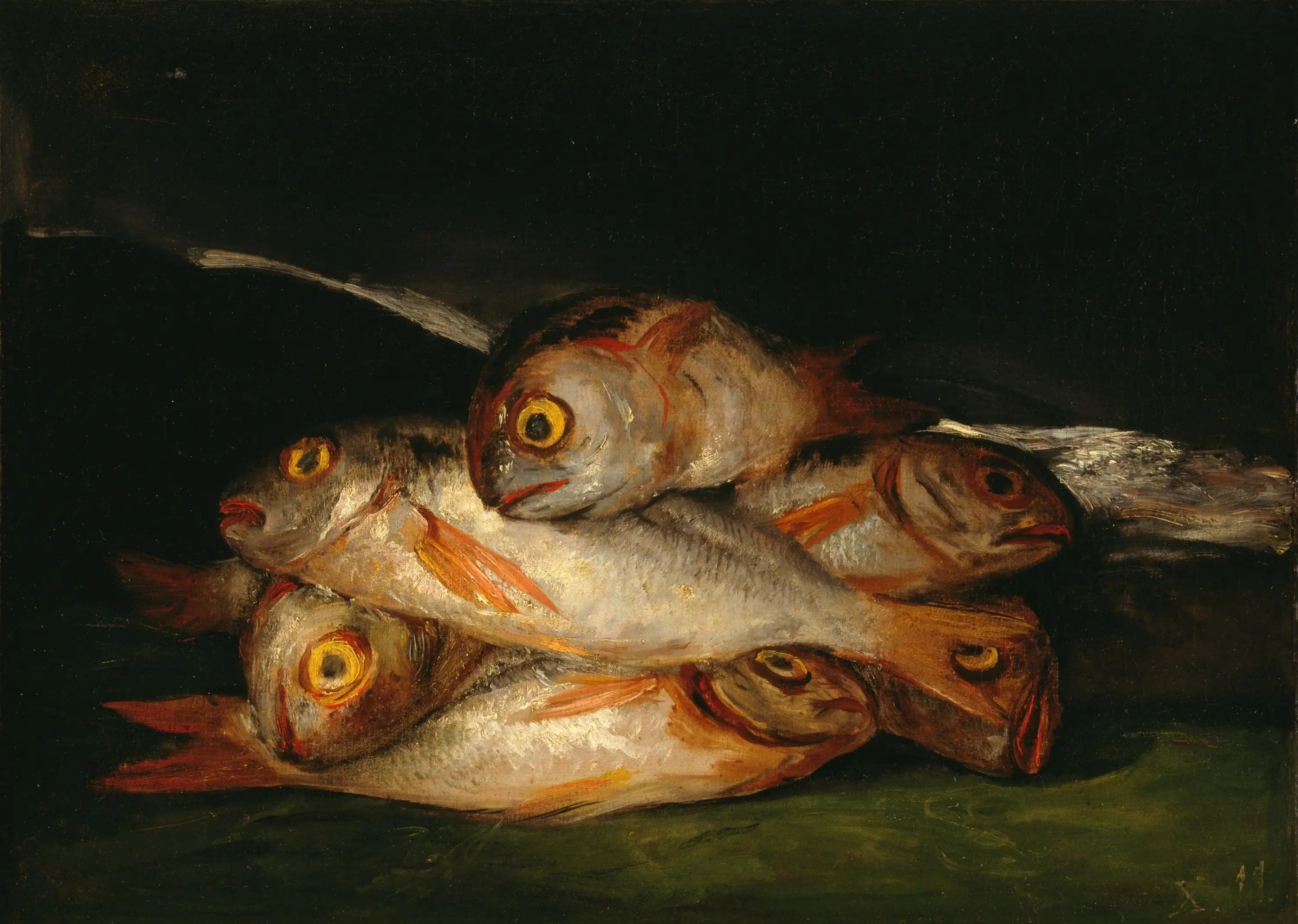
Still Life with Golden Bream
- Original dimensions
- 62.5 x 44.8 cm
- Museum
- Museum of Fine Arts, Houston
- Year
- 1808
Scene depicted
The scene depicted in this canvas is a striking still life, where a golden bream rests on a table covered with luxurious fabrics. The nuances of light caress the shiny scales of the fish, accompanied by fruits and everyday objects, as if to evoke the abundance of flavors from land and sea. Each element composes a visual harmony, demonstrating Goya's mastery in making life tangible through his canvas .
Historical context
Created in 1808 in Madrid, this painting is part of the romantic movement and reveals a crucial moment in Spanish artistic history. At that time, Spain is at a crossroads, between tradition and modernity. Currently, this canvas is located at the Museum of Fine Arts, Houston, where it continues to fascinate the public with its delicate composition and expressiveness. With dimensions of 62.5 x 44.8 cm, every detail of this canvas invites contemplation.
Place in the artist's career
The painting “Still Life with Golden Bream” is situated at a pivotal moment in Goya's career, reflecting his artistic maturity. This canvas could be paralleled with “Las Meninas” by Velázquez, from which Goya draws inspiration for light and texture, as well as with “The Executions of May 3rd” which reflects his commitment to a darker reality. Thus, we observe a palpable evolution towards a more personal and introspective expressiveness.
Anecdote
“Inspiration arises from the depths of everyday life, laden with stories to tell.” This is how Goya might describe the moment of creating this masterpiece . Imagine a spring morning in Madrid, where light plays on the cobblestones. A peaceful atmosphere reigns, only broken by the distant bustle of the fish market; every scent, every sound, anchors itself in the artist's memory and is then translated into the evocative power of this painting .