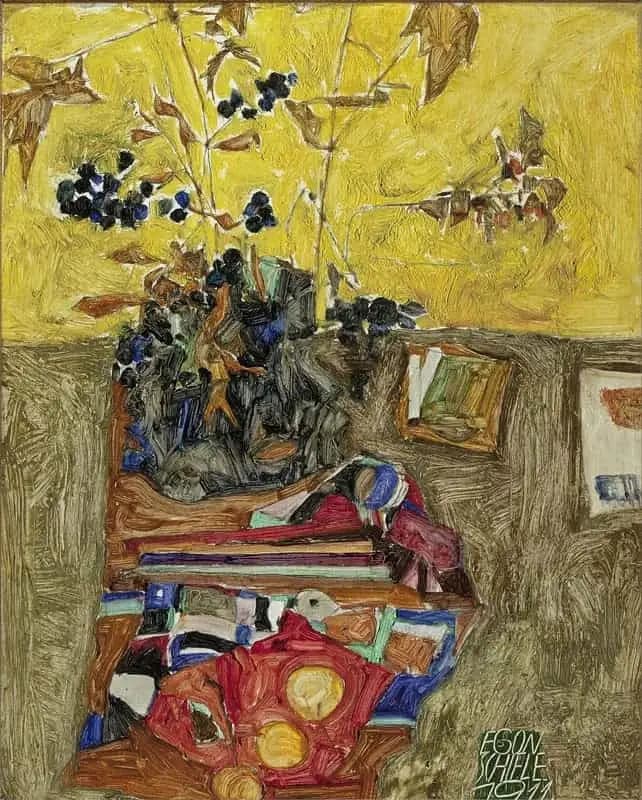
Still Life with Flowers
- Original dimensions
- 27.5 x 34 cm
- Museum
- Veletržní palác
- Year
- 1911
Scene depicted
The canvas “Still Life with Flowers” unfolds a unique composition, where each flower stands with graphic vigor. This painting does not merely represent floral beauty: it expresses the fragility of existence, evoking an ephemeral dance between life and death. The vibrant hues speak of a world where art and nature meet in an essential dialogue.
Historical context
Created in 1911, this painting is emblematic of the expressionist movement, which emerged in the early 20th century in Europe, with a particular focus on interiority and subjectivity. The work is currently housed at the Veletržní palác in Prague, in a rich cultural setting where it interacts with other masterpieces of the time. Its modest size, 27.5 x 34 cm, invites intimate and personal contemplation.
Place in the artist's career
This painting fits into the tumultuous career of Egon Schiele , marking a stage where he reaffirms his bold and innovative style. At this time, he had already produced other major works such as “Self-Portrait with a Death Mask” and “The Lovers,” reflecting his artistic exploration of the human figure and nature. “Still Life with Flowers,” although less conventional, proves to be a pivot towards a more subtly expressive language.
Anecdote
“Every flower has its story, and behind every petal, a secret hides.” There is no doubt that this thought resonated with Egon Schiele as he became captivated by the delicate details of this still life. One bright morning, in his small studio in Vienna, he captured the ephemeral beauty of the flowers, transcribed with emotional intensity in his painting .