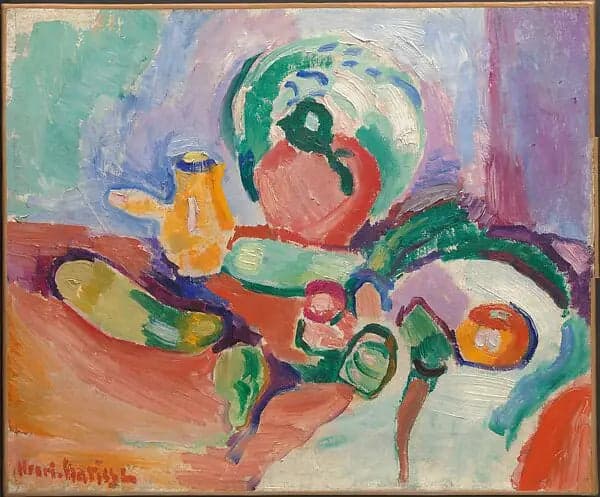
Still Life with Cucumber
- Original dimensions
- 46 x 38.4 cm
- Museum
- Metropolitan Museum of Art
- Year
- 1905
Scene depicted
In this painting , Matisse captures the essence of nature, intertwining elements of everyday life in a harmonious and dynamic composition. The colorful, simplified forms come to life: the cucumber stands proudly, testifying to a new way of observing the world. The work enjoys a visual balance conducive to meditation, captivating the viewer with its bright light and vibrant hues.
Historical context
Created in 1905, this painting is part of the Fauvist movement, of which Matisse is one of the emblematic figures. The painting is displayed at the Metropolitan Museum of Art in New York, a place that celebrates the innovation and modernity of its time, and which also houses other masterpieces of the 20th century. During this period, Matisse explores a bold palette and a style that breaks traditional conventions of the canvas .
Place in the artist's career
The still life with cucumber represents a turning point in Matisse's career, marking the beginning of his exploration of Fauvism . Alongside this painting , one can mention The Dance and The Joy of Life , which illustrate the progression of his bold style and chromatic explorations. These works demonstrate his growing talent for playing with color to create emotion.
Anecdote
“Painting should be a visual feast, a celebration of life,” said Matisse, thinking of his canvas . Imagine the moment of inspiration: a bright morning in Nice, where the light dances on the fruits and reveals the beauty of natural forms. This emotion lies at the root of the still life with cucumber , imbued with simple joy.
Major exhibitions
Twentieth-Century Modern Masters: The Jacques and Natasha Gelman Collection