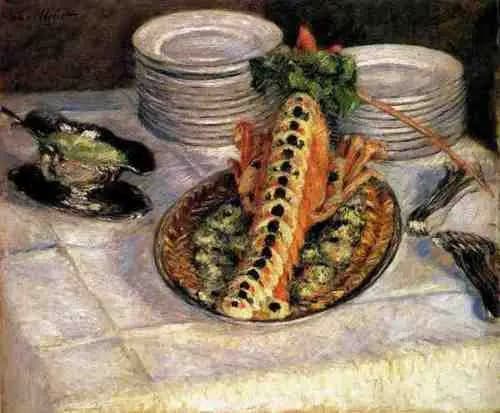
Still Life with Crayfish
- Original dimensions
- 72 x 58 cm
- Museum
- Not specified
- Year
- 1881
Scene depicted
The painting “Still Life with Crayfish” immerses us in a delicate universe where the elegance of the crayfish, meticulously arranged on a wooden table, interacts with the light that caresses them. Each element, from the drapery to the accessories, invites us to savor the simple pleasures of life, reminiscent of refined French gastronomic culture.
Historical context
Created in 1881, the painting emblematic of Gustave Caillebotte is part of the Impressionist movement. Its refined appearance evokes Paris at the end of the 19th century, a time marked by unprecedented artistic effervescence. The canvas , not currently exhibited in a specific museum, remains a precious piece of cultural heritage. Its dimensions, 72 x 58 cm, make it a masterpiece with a commanding presence.
Place in the artist's career
This canvas , although created relatively early in Caillebotte's career, marks a significant milestone, illustrating the evolution of his style. Alongside his later works, such as “The Floor Scrapers” and “The Seine at Argenteuil,” “Still Life with Crayfish” reveals a shift towards exploring the nuances of light and form.
Anecdote
“Every painting I create is an open window to a timeless moment.” Such could be the words of the master, inspired by the sweet scent of a sunny morning, as he carefully arranged the elements of his composition. In this work, Caillebotte immortalizes the ephemeral beauty of a still life, creating a vibrant and friendly atmosphere.