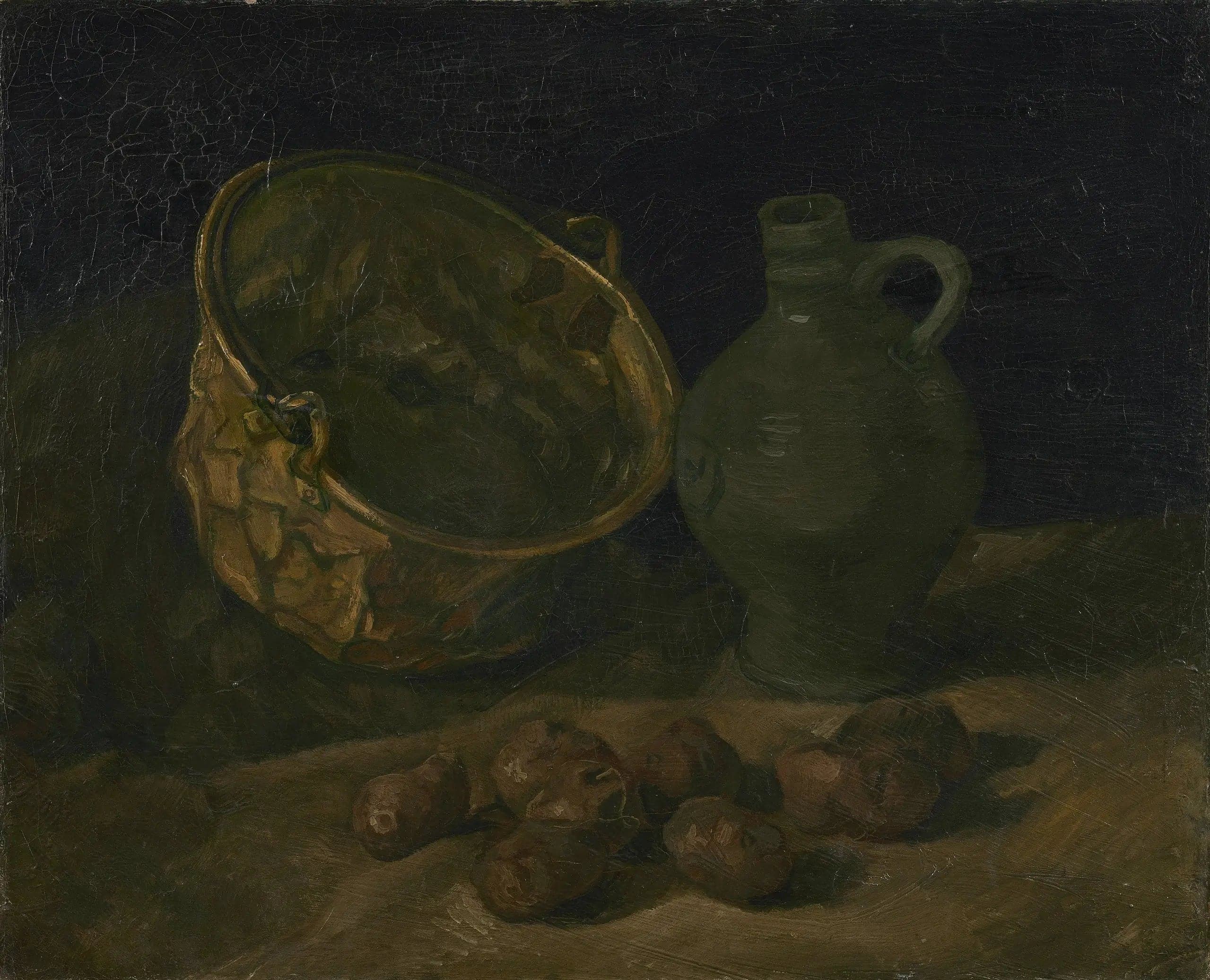
Still life with cauldron and brass jug
Scene depicted
This canvas immerses us in the intimacy of a humble kitchen, where a cauldron and a brass jug seem to engage in a silent dialogue. Through this choice of everyday objects, Van Gogh pays tribute to the simplicity of life and the intrinsic beauty of still life, thus transcending the mundane into eternal visual arts.
Historical context
Created in 1885, in Nuenen , this painting is part of the post-impressionist movement, a barometer of an era when art breaks free from conventions. The current composition of the canvas is located at the Van Gogh Museum , a sanctuary for admirers of this artistic genius. Measuring 80.5 x 65.5 cm, this pictorial work evokes rich avant-garde legacies.
Place in the artist's career
Still Life with Cauldron and Brass Jug is situated at a pivotal moment in Van Gogh's career, where he explores new techniques while asserting his distinctive style. Compared to his works such as The Sunflowers and The Starry Night , this canvas reveals a quest for emotional depth while establishing a more subdued and earthy palette.
Anecdote
Vincent van Gogh once said: “The calm of a still life scene absent from the hustle of life gives me great inner depth.” It is this breath of tranquility that gave birth to Still Life with Cauldron and Brass Jug in morning light, as the artist observed with fascination the objects of daily life.