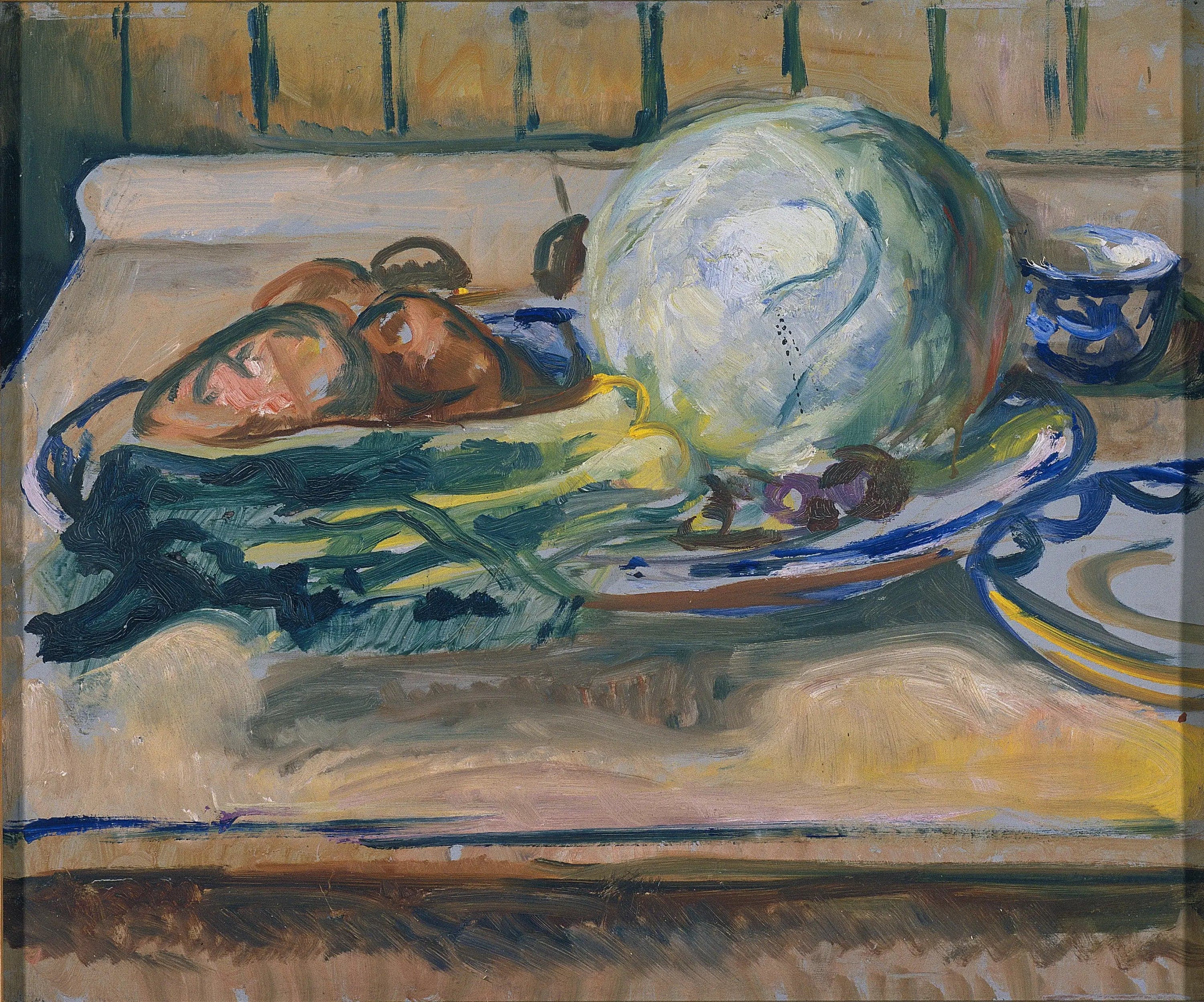
Still Life with Cabbage and Other Vegetables
- Original dimensions
- 55 x 45.5 cm
- Museum
- Munch Museum
- Year
- 1926
Scene depicted
The painting “Still Life with Cabbage and Other Vegetables” delicately depicts a harmonious composition of natural elements. Dominated by fresh vegetables, notably a majestic cabbage, this pictorial work magnifies the everyday and celebrates the beauty of simple pleasures in life. The colors and textures interact to tell a vibrant story, inviting the viewer to dive into the warm atmosphere of this frozen moment.
Historical context
Created during a time rich in contrasts, Still Life with Cabbage and Other Vegetables represents a period when Edvard Munch explores the vitality of everyday life in Oslo. Anchored in the vibrant city of Oslo, Norway, this painting illustrates the expressionist movement, characterized by the release of emotions. The canvas is currently exhibited at the Munch Museum, which preserves the artistic legacy of the artist within its walls, echoing his remarkable journey.
Place in the artist's career
Positioning this canvas in Munch's career, it serves as an anchor point, between his period of takeoff and his artistic maturity. Like The Madonna and The Scream , “Still Life with Cabbage and Other Vegetables” shares this quest for the expression of deep emotions and visceral life. It testifies to a rich journey, illustrating the evolution of style and the heightened sensitivity of the artist.
Anecdote
“In exploring the everyday, I seek the hidden beauty, the one that flourishes in simple gestures,” Munch confided during the creation of this masterpiece . It was a late summer morning, the light played in the kitchen, awakening a peaceful inspiration within him. This intimate atmosphere is deeply rooted in the canvas , like a breath of vibrant life in every detail.
Major exhibitions
Munch og Ekely: 1916-1944