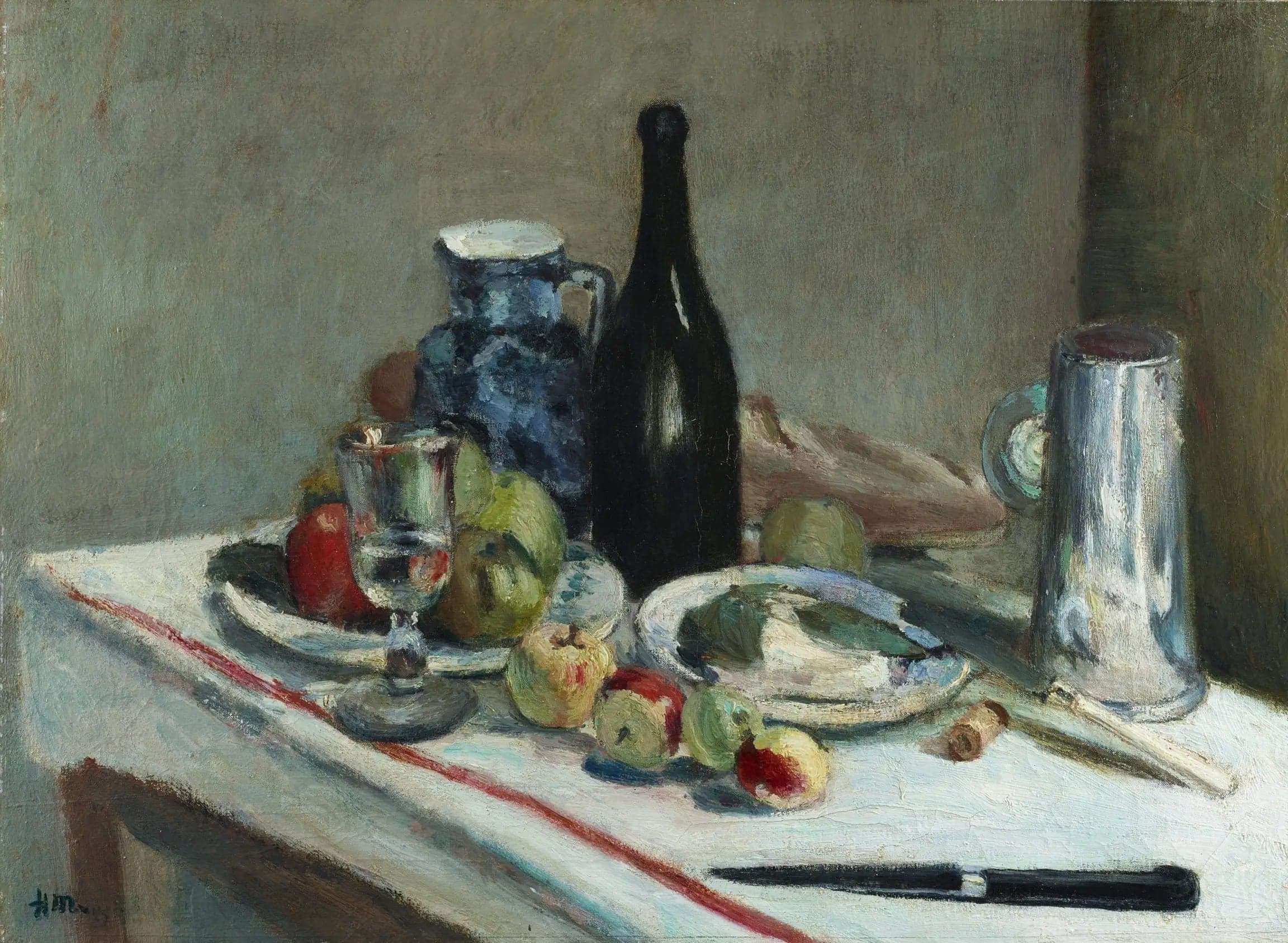
Still Life with Black Knife
- Original dimensions
- 81 x 59 cm
- Museum
- Cantonal Museum of Fine Arts in Lausanne
- Year
- 1896
Scene depicted
The canvas “Still Life with Black Knife” is a celebration of forms and colors, where common objects become actors in a vibrant scene. Through bold hues and delicate shadows, Matisse transcends the everyday, making each element significant. The black knife, a symbol of art, proudly reigns, highlighting the harmony between the object and the space that surrounds it.
Historical context
Created in 1896 in Nice, this painting illustrates a key moment of the Fauvist movement, anchoring Henri Matisse at the heart of the artistic avant-garde of the late 19th century. Set against a gentle Mediterranean light, this canvas is now housed in the prestigious Cantonal Museum of Fine Arts in Lausanne , where visitors can admire its unique proportions and vibrant composition.
Place in the artist's career
This canvas fits into a prolific period for Matisse, marking a decisive turning point in his artistic journey. Alongside “The Dancer” and “The Joy of Life,” “Still Life with Black Knife” illustrates his bold exploration of color and composition, underscoring his indispensable role in the transformation of modern art.
Anecdote
“Color is the language of inspiration,” Matisse would say during his walks by the sea. One sunny morning, it was there, in a quiet corner, that he spotted the gleam of a black knife resting among vibrant fruits. This fleeting encounter awakened in him the desire to capture that magic, thus bringing his masterpiece to life.