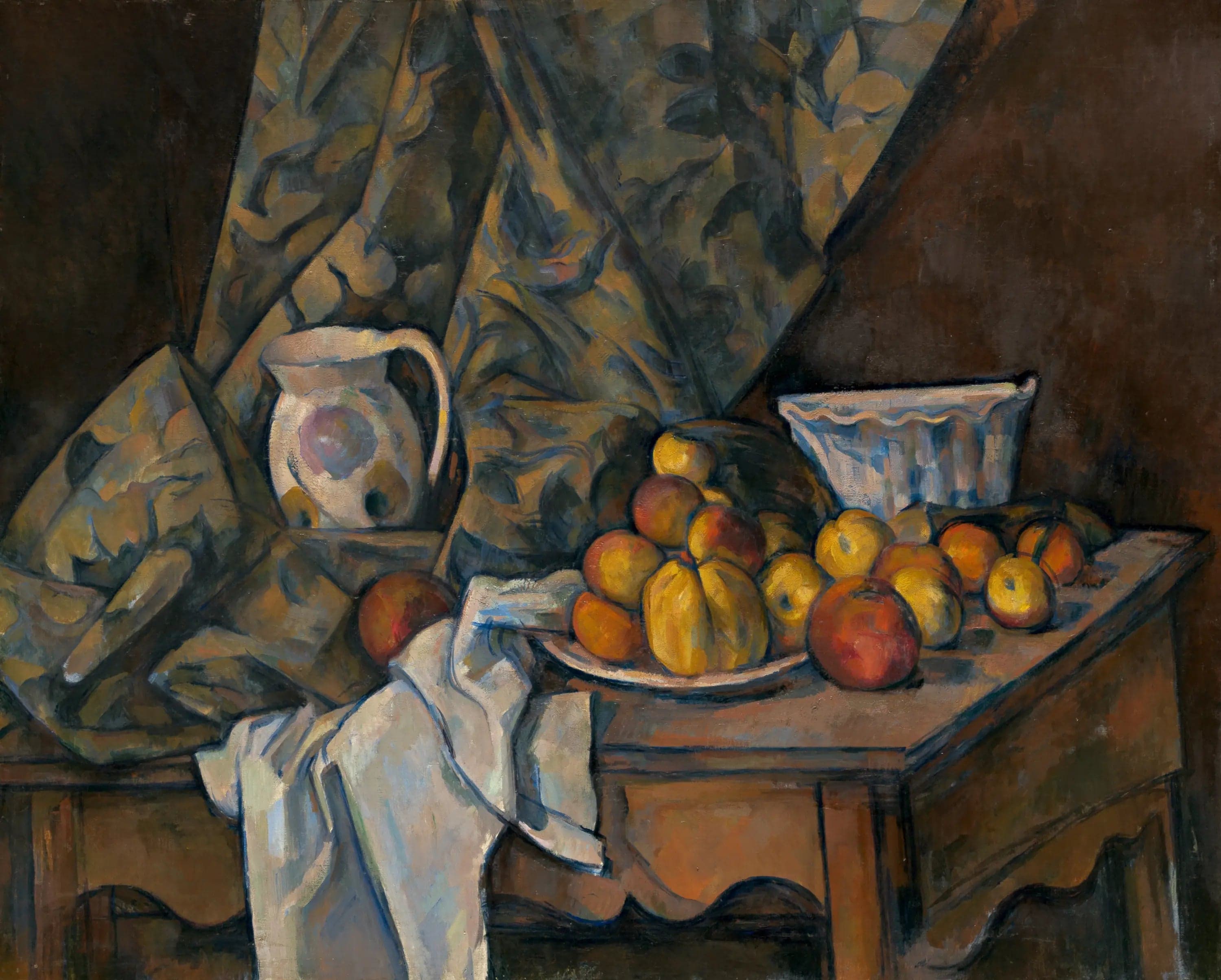
Still Life with Apples and Peaches
- Original dimensions
- 100.5 x 81 cm
- Museum
- National Gallery of Art
- Year
- 1905
Scene depicted
The painting “Still Life with Apples and Peaches” unfolds with exquisite delicacy. Juicy fruits, apples, and peaches are gathered on a table, testifying to the ephemeral beauty of nature and daily life. The shapes are simplified, almost geometric, reflecting Cézanne's unique approach. This canvas tells a story of season, harvest, and sharing, while captivating the viewer with its maternal density.
Historical context
Created in 1905, this painting is emblematic of the post-impressionist movement in Aix-en-Provence, the artist's birthplace. It is a time when Cézanne strives to transform nature into a dynamic and structured composition , interrupted by bursts of color. The powerful National Gallery of Art currently houses this canvas , an invaluable treasure at the crossroads of classical and modern art.
Place in the artist's career
“Still Life with Apples and Peaches” is part of a pivotal period in Cézanne's career, where he explores the notion of volume and perspective. With paintings such as “The Card Players” and “The Montagne Sainte-Victoire,” we observe a journey where the artist refines his style and redefines the perception of painting , thus marking modern art.
Anecdote
“Nature is within me, so I express it in my own way.” These words, spoken on a spring morning, gave birth to a masterpiece that captures the spirit of French rurality. Cézanne immersed himself in the simplicity of nature to create a living work, filled with light and emotion. The canvas becomes an echo of his intimate inspirations.