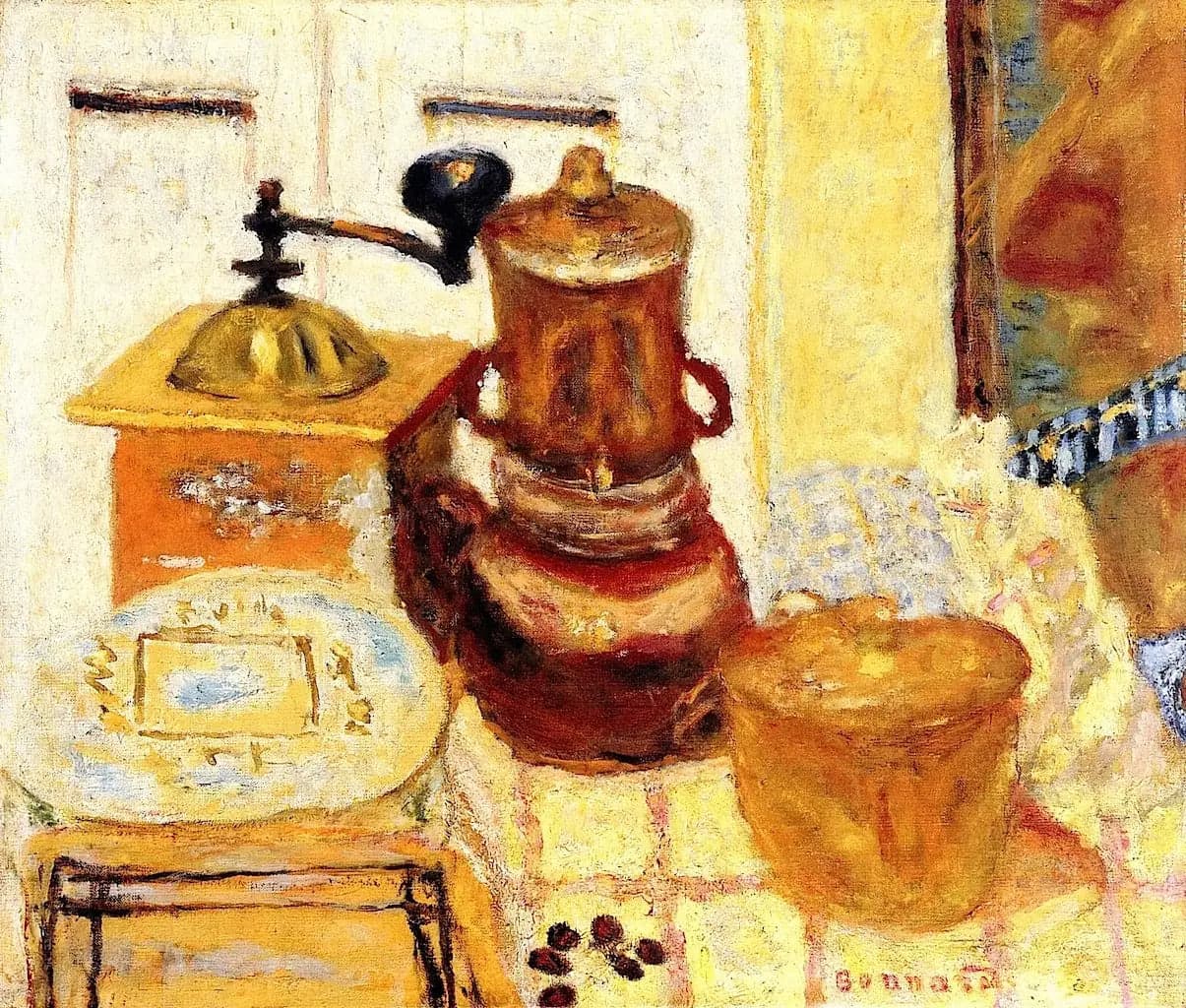
Still Life: The Coffee Mill
- Original dimensions
- 57 x 48 cm
- Museum
- building of the Fine Arts Museum of Winterthur
- Year
- 1930
Scene depicted
The canvas “Still Life: the Coffee Mill” stands out for its delicate arrangement of everyday objects; the coffee mill, a symbol of the morning ritual, is surrounded by simple foods and soft light. It is a tribute to domestic life, where meticulous aesthetics combine with a deep reflection on time, memory, and the intimacy of mundane gestures.
Historical context
Created in 1930, this iconic work by Pierre Bonnard reflects the Nabi movement, an artistic current rich in colors and emotions. The painting, currently exhibited at the Fine Arts Museum of Winterthur, unfolds in a vibrant cultural setting, at the heart of a Europe in full artistic effervescence. Its dimensions, 57 x 48 cm, invite intimate and immersive contemplation.
Place in the artist's career
This painting positions itself as an essential milestone in Bonnard's career, revealing his characteristic style and obsession with light. In parallel, other works such as “The Lunch” and “The Woman with Cherries” show how his art evolves, moving from an exploration of color to an increased fascination with domestic atmospheres.
Anecdote
“Light plays its notes on the intimate, and each color is a whisper of the everyday,” Bonnard might have declared while reflecting on his creation. This masterpiece was born from a fleeting moment, a morning bathed in spring light, where the simple coffee mill captured his gaze, vibrating with ephemeral and delicate beauty.