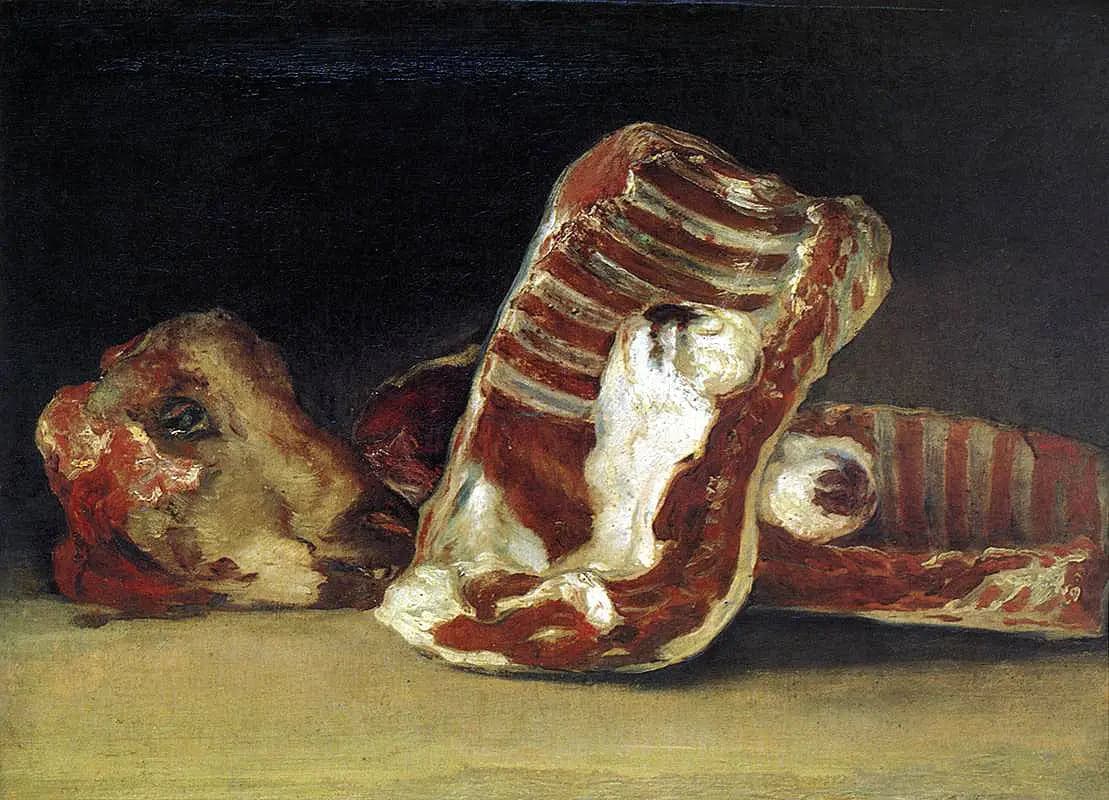
Still Life
- Original dimensions
- 62 x 45 cm
- Museum
- Not specified
- Year
- 1808
Scene depicted
This painting highlights a delicately arranged scenography of fruits, flowers, and everyday objects, all concealing the subtleties of existence. Goya lingers on the details, suggesting a tranquility fragile under the anxiety of modern times. The harmony of the elements composes a pictorial work where each object comes to life, evoking personal and universal narratives.
Historical context
Created in 1808, Still Life at is rooted in the tumultuous context of the struggle for Spanish identity. It is in the heart of Madrid, a city passionate about art and culture, that Francisco de Goya , an emblematic figure of the romantic movement, conceived this work. The painting reflects the struggles and passion of a pivotal time, at a moment when Spanish society is undergoing profound transformation. This painting , although not preserved in a well-known museum, remains a centerpiece that evokes the intensity of human emotions.
Place in the artist's career
Still Life at represents a fundamental step in Goya's career, testifying to his ability to navigate between tradition and innovation. Let us choose to compare it to "La Maja Desnuda" and "The Executions of May 3rd", two paintings that reveal the evolution of his style, moving from classical representation to a more striking expressiveness.
Anecdote
“Art must not only represent beauty, it must capture the human soul.” This quote resonates strongly in the genesis of the masterpiece . Imagine Goya, losing his gaze in a sunlit alley, soaking in the soft light of a spring morning, thus forging a deep connection with the natural world, pulsing with vital energy. This intimate scene gave birth to the palpable emotion that emanates from Still Life at .