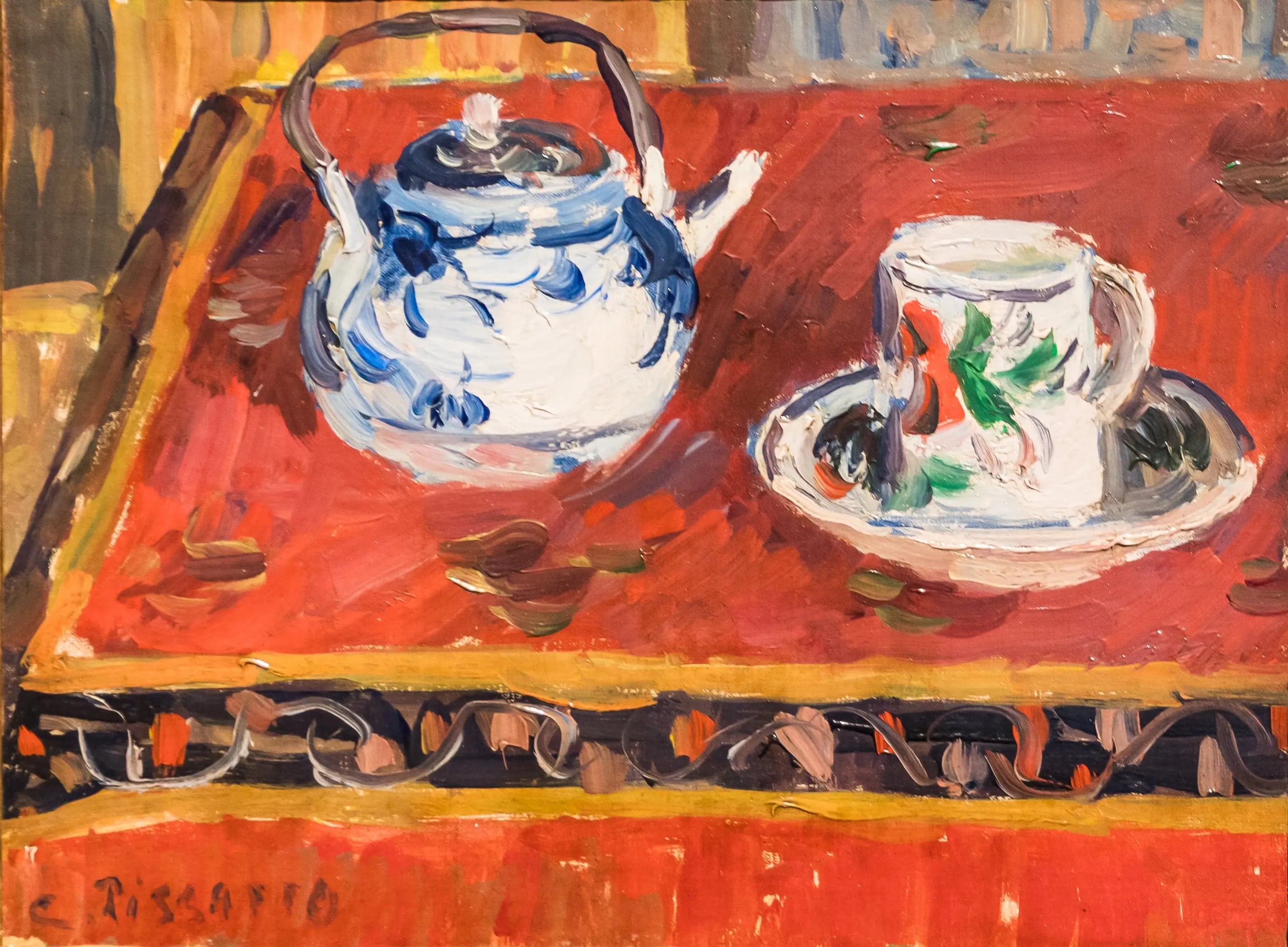
Still Life, Cup and Teapot
- Original dimensions
- 28 x 21.4 cm
- Museum
- Langmatt Museum Sidney and Jenny Brown Foundation
- Year
- 1899
Scene depicted
This canvas presents a harmonious composition of delicate cups and a teapot, arranged on a table. Each element is carefully chosen to evoke the tranquility of a shared moment, where shadow and light dance on the satin surfaces. The scene narrates the silent dialogue between the objects, a visual poetry full of delicacy and human warmth.
Historical context
Created at the end of the 19th century, this painting immerses us in bohemian Paris, a vibrant city rich in artistic avant-garde. It was in 1899 that Camille Pissarro , a major figure of the Impressionist movement, created this work, now preserved at the Langmatt Museum in Switzerland. The canvas reveals refined technical skill while testifying to a transitional era, where the lights of modernity illuminated compositions that were both bold and intimate.
Place in the artist's career
Still Life, Cup and Teapot represents a pivotal moment in Pissarro's career. This masterpiece is situated in the mature phase of the artist, where his style asserts itself with increased intensity. Alongside Garden at Éragny and The Place du Havre , this work reflects his exploration of light and colors, showing a technical evolution where each canvas emits a unique emotion.
Anecdote
“The simplicity of everyday objects is an unknown beauty,” said Pissarro. Imagine him, one spring morning, observing the light filtering through the window of his studio. It is here that the painting takes shape, inspired by this atmosphere, distilling a palpable sweetness where each element of the canvas tells a story.