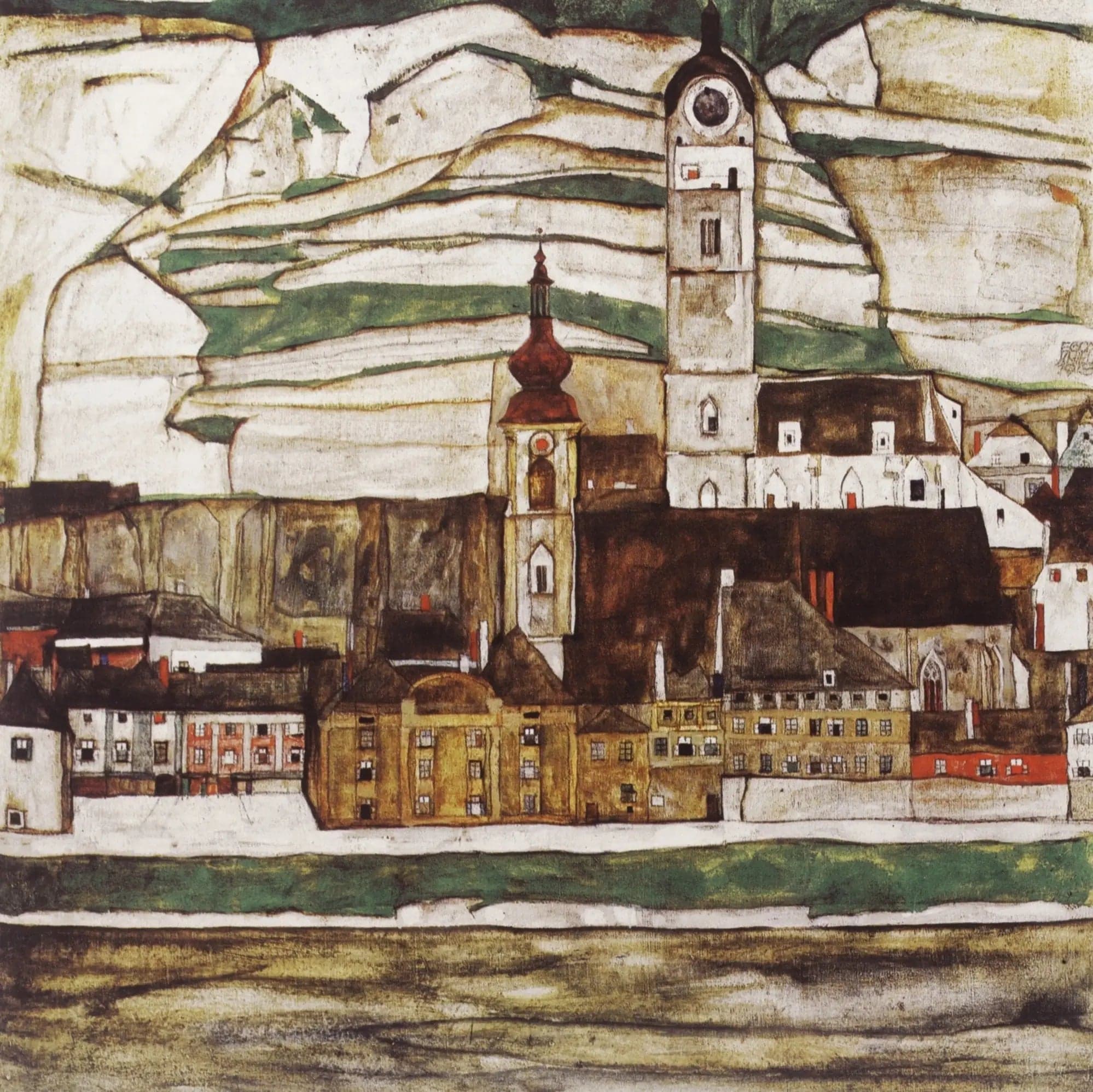
Stein on the Danube, viewed from the south
- Original dimensions
- 89.5 x 90.2 cm
- Museum
- Neue Galerie
- Year
- 1913
Scene depicted
The painting “Stein on the Danube, viewed from the south” is a vibrant interpretation of the Austrian landscape, where the undulations of the Danube stretch beneath a bright sky. The composition draws its strength from the interaction between terrestrial architecture and the serenity of the water, while the canvas captures the delicate movement of clouds in the sky. Every detail is stylized, creating an almost palpable atmosphere of tranquility and mystery that invites contemplation.
Historical context
Created in 1913, this painting emblematic of Egon Schiele represents a poetic window onto Stein, a town located in Austria, in the picturesque region of the Danube. At that time, the expressionist movement, of which Schiele was a key figure, sought to capture raw emotions through stylized forms and vibrant colors. The canvas is currently housed at the Neue Galerie, where it continues to evoke admiring glances. With its impressive dimensions of 89.5 by 90.2 cm, this painting is a true masterpiece that aspires to transport the viewer to the heart of Schiele's artistic experience.
Place in the artist's career
In the artistic trajectory of Egon Schiele , this painting marks a pivotal period of maturity. It is part of a body of work that, while evoking landscapes, reveals his evolving technical skills, as seen in his other famous paintings : “The Danube” and “Self-Portrait with Raised Arm.” These works all testify to his evolution towards the search for a profound artistic language, rooted both in nature and in human expression.
Anecdote
“I paint with a passion that burns like fire,” said Schiele. Inspired one morning by the fleeting light of the rising sun over the Danube, he immortalized this precious moment of natural and serene beauty. This fleeting moment gave birth to a pictorial work that embodies the intensity of emotions, making Stein on the Danube an echo of nature itself.