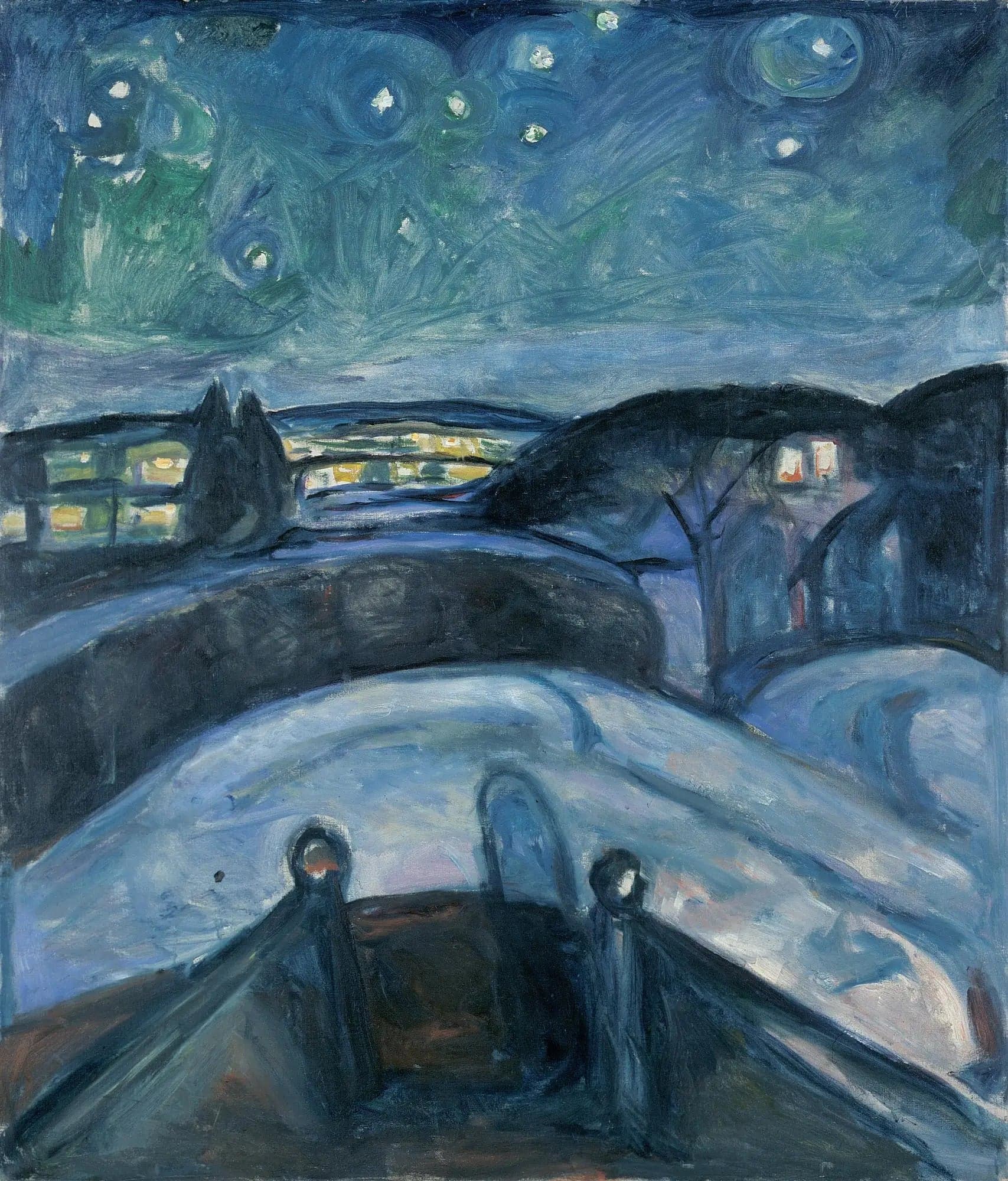
Starry Night
- Original dimensions
- 74 x 59.5 cm
- Museum
- Folkwang Museum
- Year
- 1901
Scene depicted
Starry Night, like a calm symphony, delivers a tormented nocturnal vision. Perched above a dark and labyrinthine landscape, this painting reveals a tumultuous sky, filled with impetuous stars and a luminous moon. The vastness of the cosmos contrasts with the serenity of a sleeping village, weaving a dichotomy between calm and chaos. The surreal forms plunge the viewer into a deep reflection on the introspective journey of the individual in the face of the immensity of the universe.
Historical context
Created in 1901, during a time marked by expressionism , this painting is located in Essen, Germany, within the prestigious Folkwang Museum . This iconic painting by Munch is part of an artistic movement where emotion is highlighted, thus transcending classical forms. The painting is a window into the soul, an exploration of the human psyche rooted in its tumultuous era.
Place in the artist's career
Starry Night stands as a pivot in Munch's career, echoing his earlier works such as The Scream and The Madonna. The painting marks an evolution in the artist's style, merging symbolism with expressionism , where his line becomes freer and his use of color bolder, resulting in a palpable emotion found in this masterful composition.
Anecdote
“I paint my reality, where every starry night is a cry of the soul,” Munch is said to have mentioned during a walk through the alleys of Styria, inspired by the starry tranquility of a summer evening. This quote resonates with the intensity of his canvas , where each star seems to vibrate with its own life, urging us to contemplate the depth of our existence.