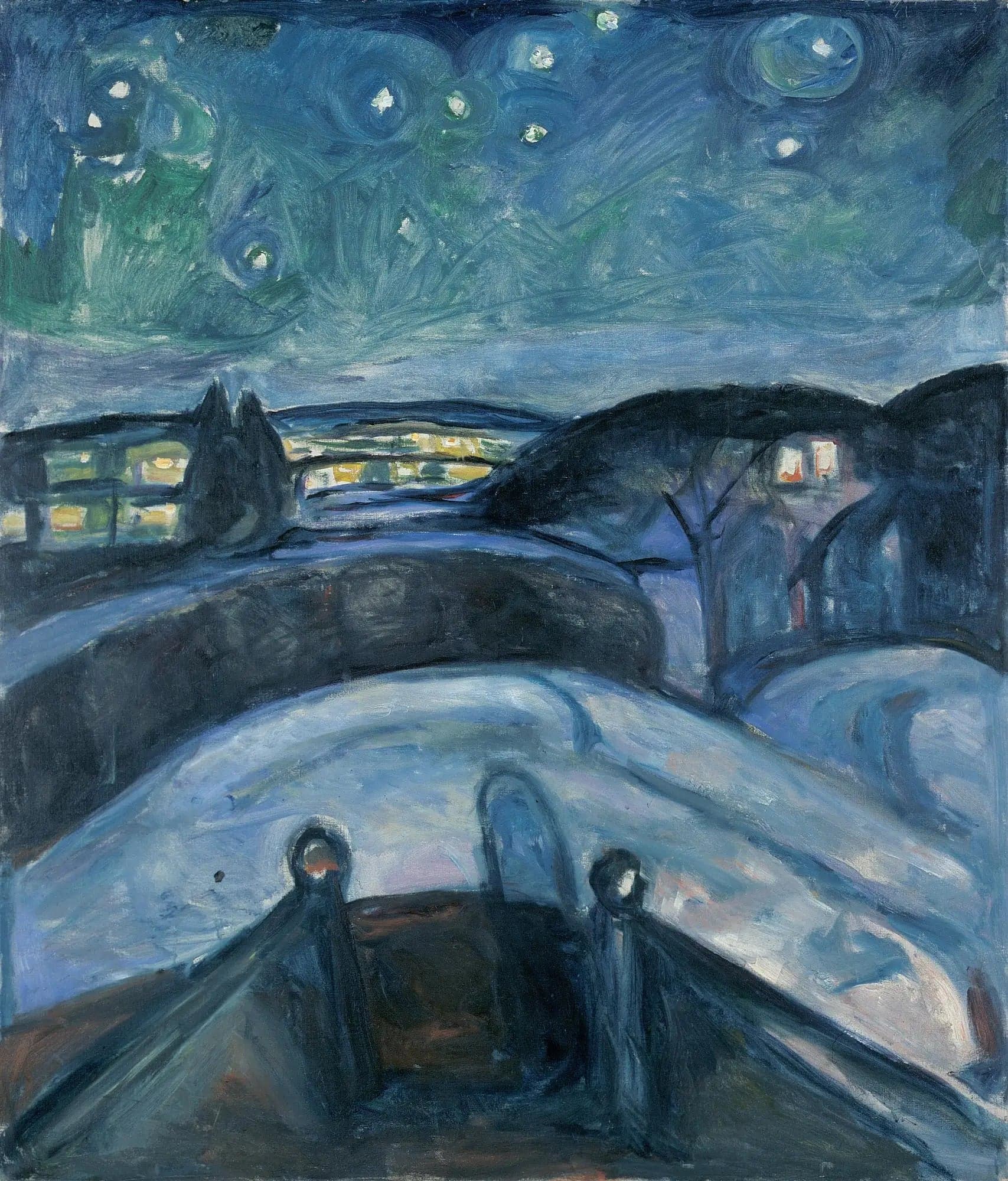
Starry Night
- Original dimensions
- 119 x 140 cm
- Museum
- Munch Museum
- Year
- 1922
Scene depicted
In the painting "Starry Night," Munch manages to capture the melancholy of the night composed of a swirling sky, where the twinkling stars seem to dance to the rhythm of a gentle breeze. The composition invites contemplation, offering the eyes a perspective of unexpected depth, as if one could enter a parallel universe, that of dreaminess and spiritual quest. Beyond the serene appearance, each brushstroke conveys an atmosphere charged with contrasting emotions.
Historical context
Created in 1922, in the heart of Oslo, this painting is emblematic of the expressionist movement, an artistic current that seeks to express emotions rather than reality. In a context of social upheaval, the canvas "Starry Night" reflects a city in full transformation. Today, you can admire this work at the Munch Museum, where it continues to evoke fascination and reflection.
Place in the artist's career
"Starry Night" represents a peak in Munch's career, reflecting his artistic evolution. Between his promising beginnings with "The Scream" and his poignant explorations in "The Madonna," the painting testifies to his ability to capture human suffering while highlighting an inert beauty. It is a key milestone, where his technique strengthens, his style sharpens, and the emotion emerges with striking clarity.
Anecdote
Edvard Munch once stated: "Color is a pandemic, and it drives our mind beyond the darkness." Perhaps this thought inspired him one spring evening as he contemplated the starry sky with a melancholy tinged with beauty. The brilliance of each star on the painting evokes not only the night but also the tormented soul of the artist. Thus, "Starry Night" becomes a reflection of his inner emotions.
Major exhibitions
Munch og Ekely: 1916-1944