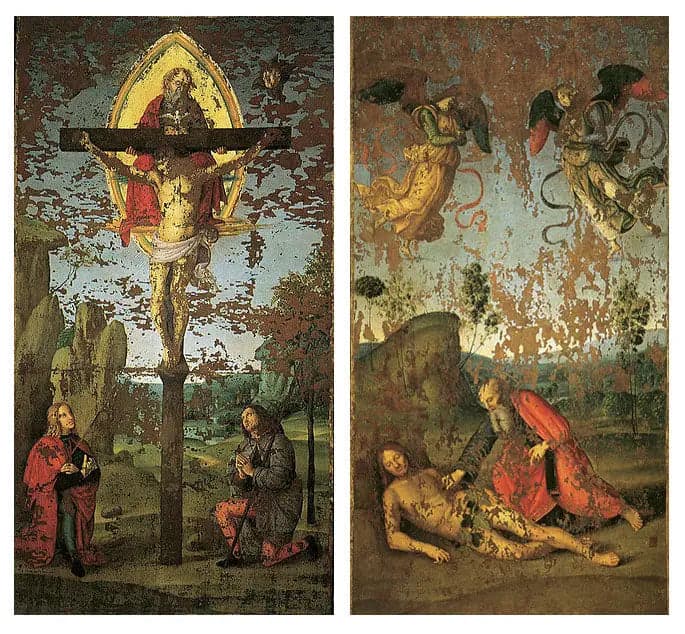
Standard of the Most Holy Trinity
- Original dimensions
- 94 x 167 cm
- Movement
- Italian Renaissance
- Museum
- Municipal Pinacoteca of Città di Castello
- Year
- 1499
Scene depicted
The painting “Standard of the Most Holy Trinity” is a captivating canvas that illustrates a moment where the divine and the earthly meet. The work evokes the Trinity in harmony, featuring majestic figures surrounded by divine light, symbolizing the presence of God among men. Every detail, every posture is meticulously thought out to convey a message of peace and devotion that transcends time.
Historical context
Created in 1499, the painting masterfully created by Raphael emerges at the heart of the Italian Renaissance , a period of artistic and intellectual renewal. This canvas is currently displayed at the Municipal Pinacoteca of Città di Castello, a museum rich in history and art that houses works by masters of the Renaissance . With dimensions of 94 x 167 cm, this pictorial work captures the very essence of a flourishing era, where harmony and beauty transcend the everyday.
Place in the artist's career
This painting is situated at a crucial turning point in Raphael's career, marking a period of artistic maturity. At this time, the artist navigates between ideal beauty and emotional richness. In parallel, the masterpiece “The Sistine Madonna” and the fresco “The School of Athens” testify to his stylistic evolution, blending complexity and harmony in the service of pictorial expression.
Anecdote
Raphael once stated: “Art does not aim merely to copy nature, but to capture its essence.” This quote resonates particularly when contemplating the masterpiece that is the Standard of the Most Holy Trinity . Imagine him, standing at dawn, a golden light filtering through the windows of his studio palace, a vision that inspires him to represent the profound spirituality and divine magnificence present in his creation.