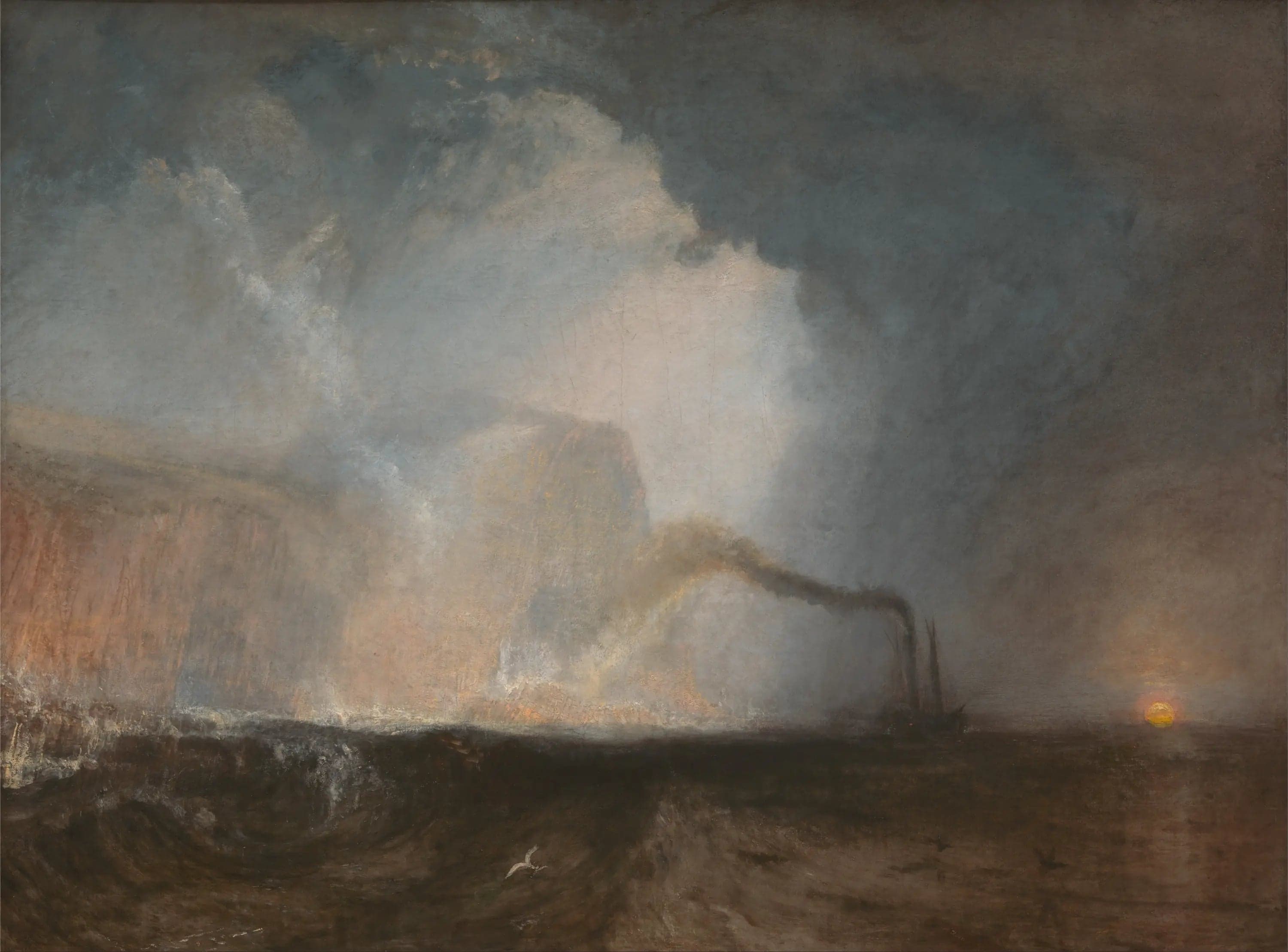
Staffa, Fingal's Cave
- Original dimensions
- 121.3 x 90.8 cm
- Museum
- Yale Center for British Art
- Year
- 1831
Scene depicted
In the painting “Staffa, Fingal's Cave,” Turner invites us to dive into an aquatic world where rock formations stand as sentinels facing the ocean. The way light caresses the natural walls reveals the grandeur and strangeness of marine landscapes, creating a dialogue between sky and sea. This powerful composition captures the very essence of a place filled with mystery and beauty. Through this canvas , Turner illustrates his deep respect for nature.
Historical context
Created in 1831, this painting emblematic of Turner evokes a time when nature, both sublime and terrifying, was at the heart of artists' concerns romantic s. Set in the enchanting backdrop of Staffa, an island in the Hebrides, this work is a striking example of the romantic movement, where personal sensations and natural spectacles merge into a canvas that is vibrant. Now preserved at the Yale Center for British Art, the painting measures 121.3 x 90.8 cm, encapsulating the essence of the sublime.
Place in the artist's career
“Staffa, Fingal's Cave” represents an important milestone in Turner's career, illustrating a period of artistic maturation. While his previous work, “The Fighting Temeraire” symbolizes a nostalgic duty, his later work, such as “Rain, Steam and Speed,” evokes modernity. This painting captures the transition from a romantic universe to a bolder exploration of light and color.
Anecdote
“The sea is much more than just a simple backdrop, it is the very soul of our experience,” Turner might have declared while contemplating the majestic waves crashing against the cliffs of Staffa. This masterpiece was inspired by the rolling of the sea and the soft morning light. This fleeting moment gave birth to a painting where each brushstroke breathes this ephemeral inspiration.