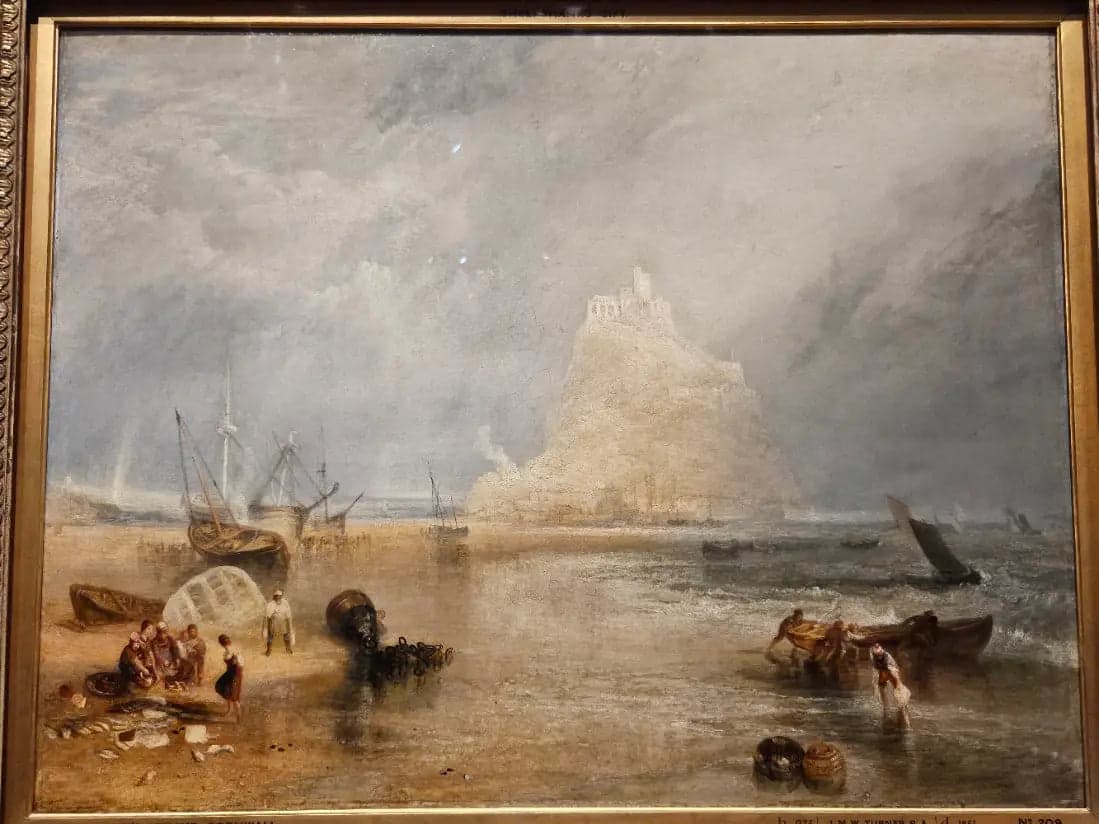
St Michael's Mount, Cornwall
- Original dimensions
- 77.4 x 61 cm
- Museum
- Victoria and Albert Museum
- Year
- 1834
Scene depicted
In this painting , Turner captures the essence of St Michael's Mount, an iconic island, connected to the world by a sandbar. The scene illustrates not only a dynamic marine landscape but also the harmony between human architecture and the force of nature. The troubled sky and the moving waters create an atmosphere of mystery, reinforcing the local identity of this canvas .
Historical context
Created in 1834, this painting is set in the enchanting landscape of Cornwall, in the southwest of England. Bequeathed to the history of British art, this work is part of the romantic movement, characterized by the expression of intense emotions and a deep respect for nature. Currently, the canvas is preserved at the Victoria and Albert Museum, a cultural landmark in London, where its precise dimensions of 77.4 x 61 cm make it a masterpiece in its own right.
Place in the artist's career
The painting “St Michael's Mount, Cornwall” can be considered a pinnacle in Turner's career. It is at this time that his style becomes bolder and more expressive. Alongside other works, such as “The Deluge” and “Rain, Steam and Speed,” this composition highlights the evolution of his work and his desire to explore more powerful atmospheric renderings.
Anecdote
“Light and water are my most faithful friends,” Turner might have declared at the twilight of a summer day, as he observed the majesty of St Michael's Mount. It is here, facing the shimmering sea and the stormy sky, that the artist would have felt the inspiration for this pictorial work . This connection to nature is found in every brushstroke of this painting , full of life and emotion.