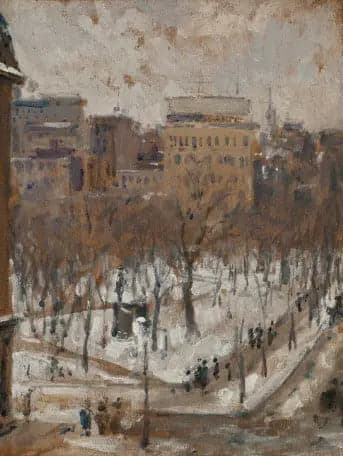
Square in Paris, Snowy Weather
- Original dimensions
- 18.8 x 23.7 cm
- Museum
- Not specified
- Year
- 1887
Scene depicted
The scene depicted in this masterpiece evokes a square in Paris, wrapped in a coat of fresh snow. The characters move, indistinct silhouettes emerging in the bright white. The atmosphere is both calm and full of life, where the shadows of the trees blend with those of the passersby, creating a perfect harmony between nature and urbanity.
Historical context
Created in 1887, this painting illustrates the Parisian winter at a time when the city was transforming under the influence of the Impressionist movement. Gustave Caillebotte , one of the pioneers of this style, captured the essence of Paris in a peaceful and cold atmosphere, representing the square under the snow. The exact location of the canvas remains unknown, but it is recognized as a masterpiece that is at the heart of 19th-century Parisian culture.
Place in the artist's career
In the career of Gustave Caillebotte , Square in Paris, snow time represents a turning point, a period of maturity where his talent refines. Alongside works like The Floor Scrapers and A Garden Path in the Snow , he demonstrates his unique approach to light and perspective, marking his influence on the Impressionist movement.
Anecdote
“In every fallen snowflake, there is a dance of shadow and light,” Caillebotte might have said while contemplating this winter landscape. This canvas was inspired during a morning walk in Paris, where the magic of a silent and pure winter seized him. This fleeting moment resonates through the evocative power of his painting .