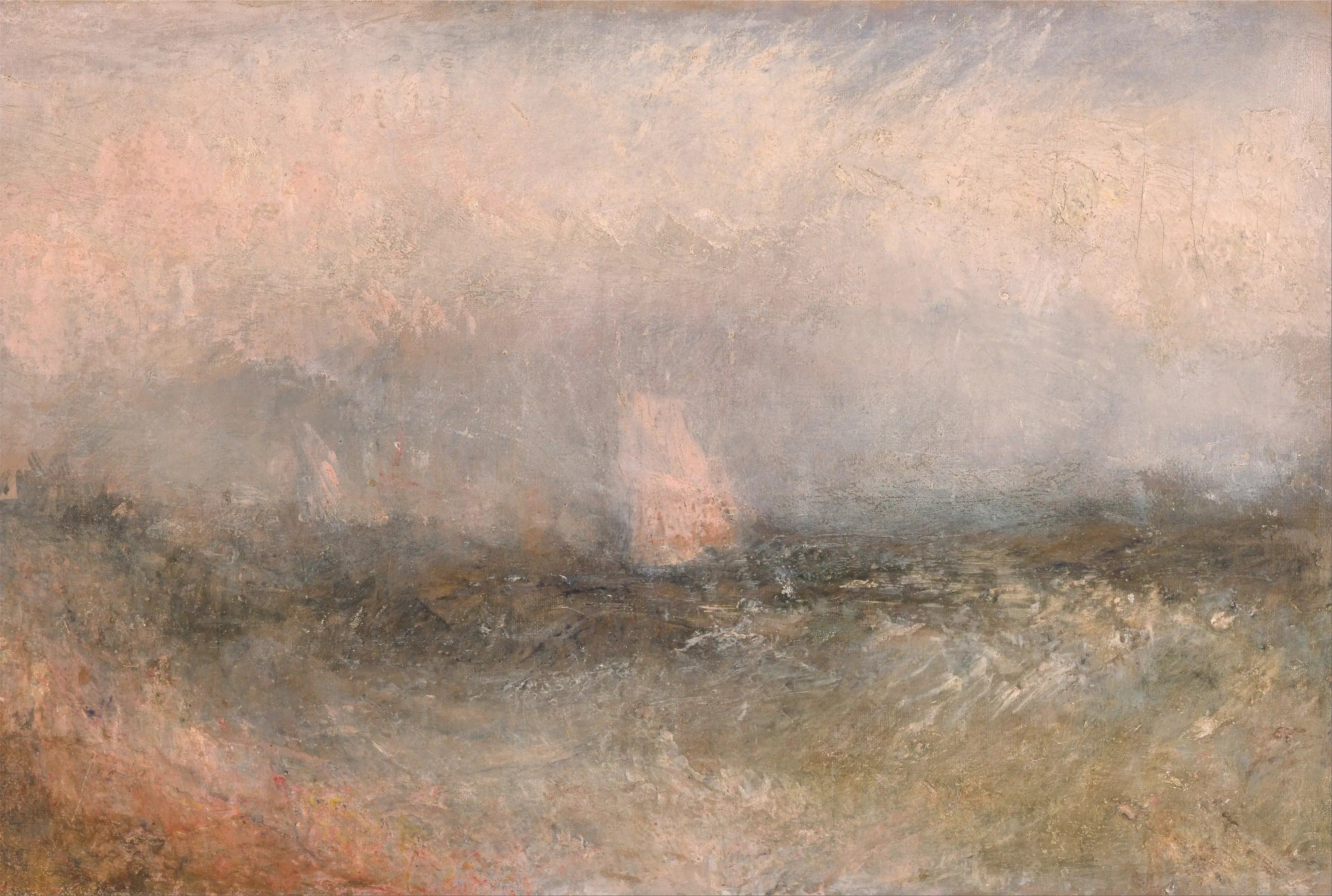
Squally Weather
- Original dimensions
- 45.7 x 30.5 cm
- Museum
- Yale Center for British Art
- Year
- 1840
Scene depicted
In the painting “Squally Weather,” Turner immerses us in the heart of an approaching storm. Dark and threatening clouds gather in a swirling sky, while the chiaroscuro brings to life the overwhelming power of nature in motion. The white sails of the ships, almost anachronistic, seem to struggle against the violence of the waves. Through this composition , Turner does not merely represent a landscape; he makes its intensity felt, transforming this canvas into a vibrant cry of nature.
Historical context
Created in 1840, this painting is emblematic and rooted in the city of London, a vibrant crossroads of artistic inspiration. Turner, an iconic figure of the Romantic movement, captured the essence of natural elements with unparalleled mastery. Currently exhibited at the renowned museum Yale Center for British Art, this captivating canvas of 45.7 x 30.5 cm represents a meeting between art and nature, where storms and lights dance in a timeless ballet.
Place in the artist's career
“Squally Weather” is at the heart of the artistic journey of a Turner in full maturity. After promising beginnings, he established himself as a pillar of Romanticism . By contrasting it with “The Deluge” and “The Wheat Field with Crows,” one perceives the impressive evolution of his work: from illustrating historical scenes to an immersive quest for visual emotions.
Anecdote
“I wanted to capture not only the storm but the very soul of the sea,” Turner might have declared while contemplating the tumultuous waves of a misty morning. It is in this thrill of adrenaline, listening to the roar of the wind and the whistling of the spray, that this pictorial work came to life, marked by raw and sincere emotion.