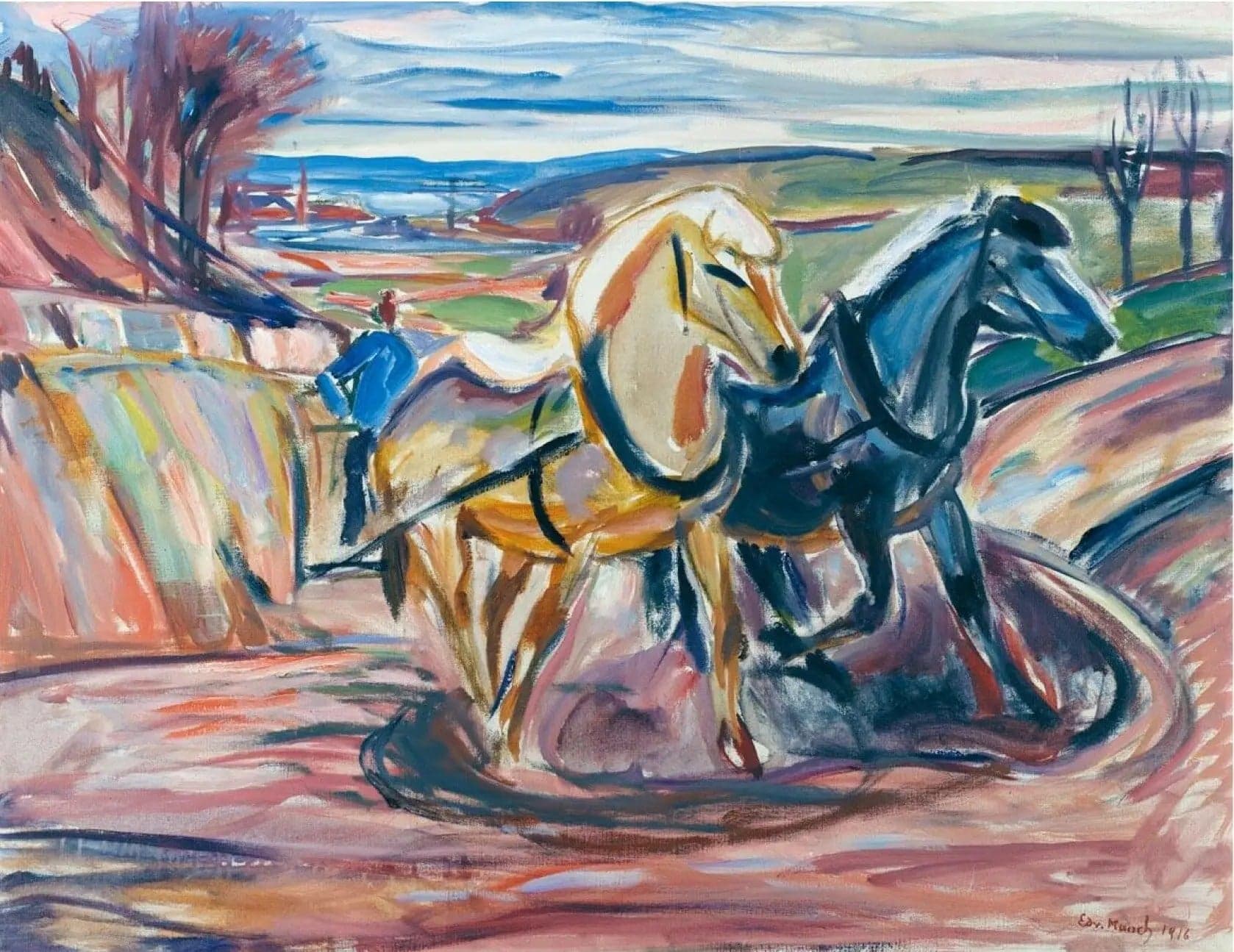
Spring Plowing
- Original dimensions
- 111 x 85 cm
- Museum
- "degenerate art" collection
- Year
- 1916
Scene depicted
In “Spring Plowing,” Munch captures a precious moment of rebirth and joy, where peasants are busy with the still damp earth. The scene highlights the vital cycle of nature, allowing greenery to redeploy after the frosts of winter. The composition, vibrant with energy, illustrates the promise of abundance and beauty, making this work a true ode to life.
Historical context
Created in 1916, in Oslo, this painting emanates from a time marked by the excitement and upheavals of World War I. Edvard Munch , emblem of symbolism and expressionism , delivers here a pictorial work that transcends its time. Currently, the canvas is found in the "degenerate art" collection, a fund that bears witness to the tumultuous history of art in the 20th century.
Place in the artist's career
This canvas marks a significant milestone in Munch's career, a pivotal period of his more assertive expressionism . By comparing it to his works like “The Scream” and “The Dance of Life,” one can observe an evolution in his use of colors and shapes, as well as an intensification of emotional expression, reflecting his perpetual quest for authenticity.
Anecdote
“Life is a constant struggle for light.” This quote could well summarize the spirit that animated Munch during the creation of this masterpiece , inspired by a refreshing spring morning in an alley in Oslo. This moment of intense connection with nature infused an emotional strength into the painting , transforming it into a surge of light and life.