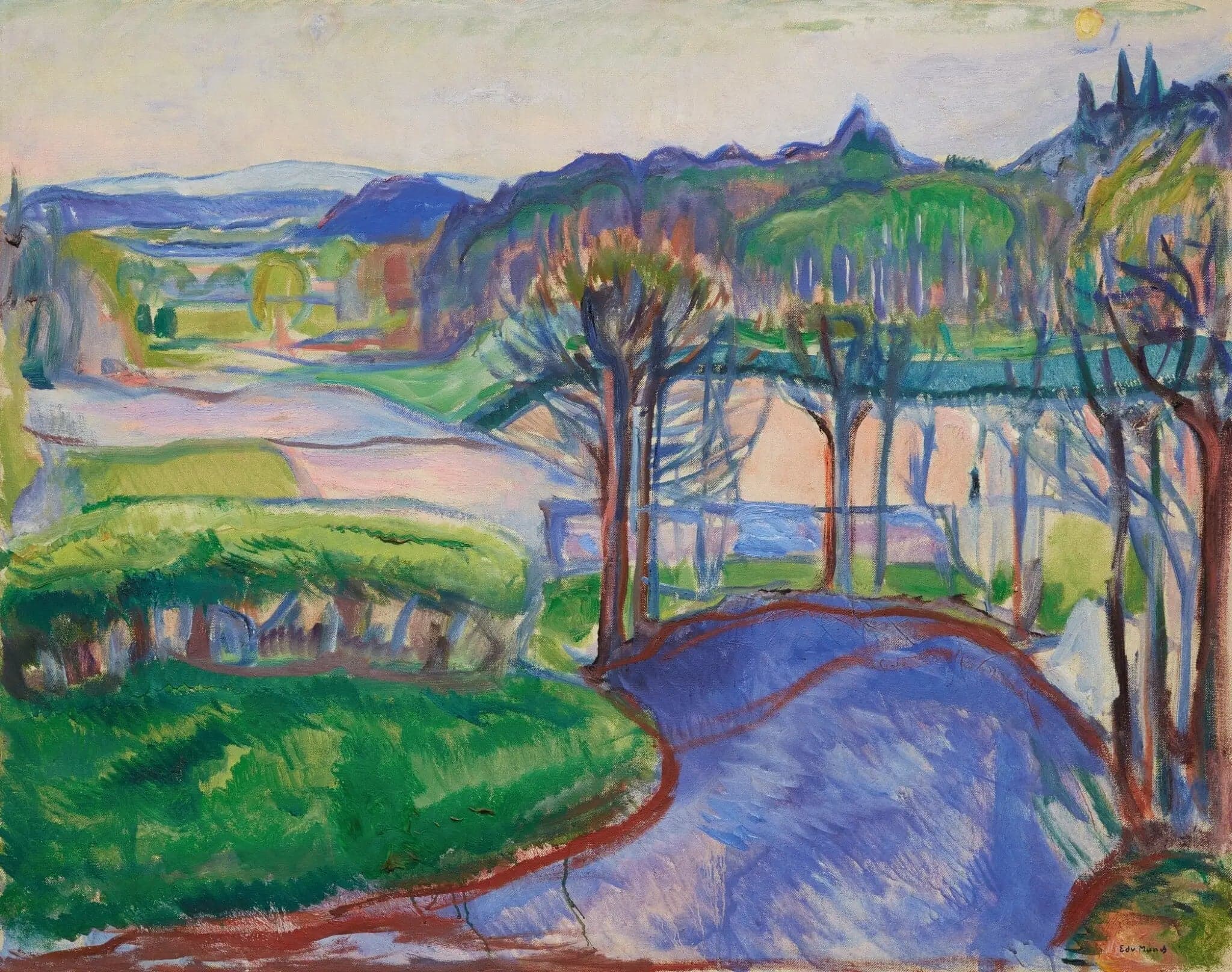
Spring Landscape
- Original dimensions
- 98 x 78 cm
- Museum
- Not specified
- Year
- 1905
Scene depicted
In this canvas , Edvard Munch immerses us in the heart of a spring landscape where blooms abound and light plays with shadows. Indeed, the pictorial work depicts a bucolic setting, where nature awakens with infinite delicacy, signifying renewal and hope. The colors intertwine in beautiful harmony, offering a contemplative experience that invites one to marvel at the beauty of the world.
Historical context
Created in 1905, this painting is part of the expressionist movement, born on the shores of the Baltic Sea while being heir to a broader pictorial tradition. Edvard Munch , a pioneer of this movement, drew his inspiration from the surrounding nature, with the fairy-tale landscapes characteristic of Norway, his homeland. Although the painting is currently not exhibited in a famous museum, it remains a flagship work of its time due to its impressive dimensions of 98 x 78 cm.
Place in the artist's career
This painting represents a pivotal period in the career of Edvard Munch . As he emerged as a major representative of expressionism , Spring Landscape reveals his penchant for a brighter and more optimistic style, in contrast to works such as The Scream and The Madonna , where emotional intensity predominates. This masterpiece testifies to his ability to shift from dark melancholy to a celebration of life.
Anecdote
"Nature is the echo of my thoughts." These words from Edvard Munch resonate as a guiding thread to understand this masterpiece . Inspired by a spring morning where the song of birds mingled with the gentle breeze, Munch captured the essence of this ephemeral brightness. The painting speaks of a suspended moment where the orchestration of colors evokes a symphony of emotions, an ode to the fleeting beauty of nature.