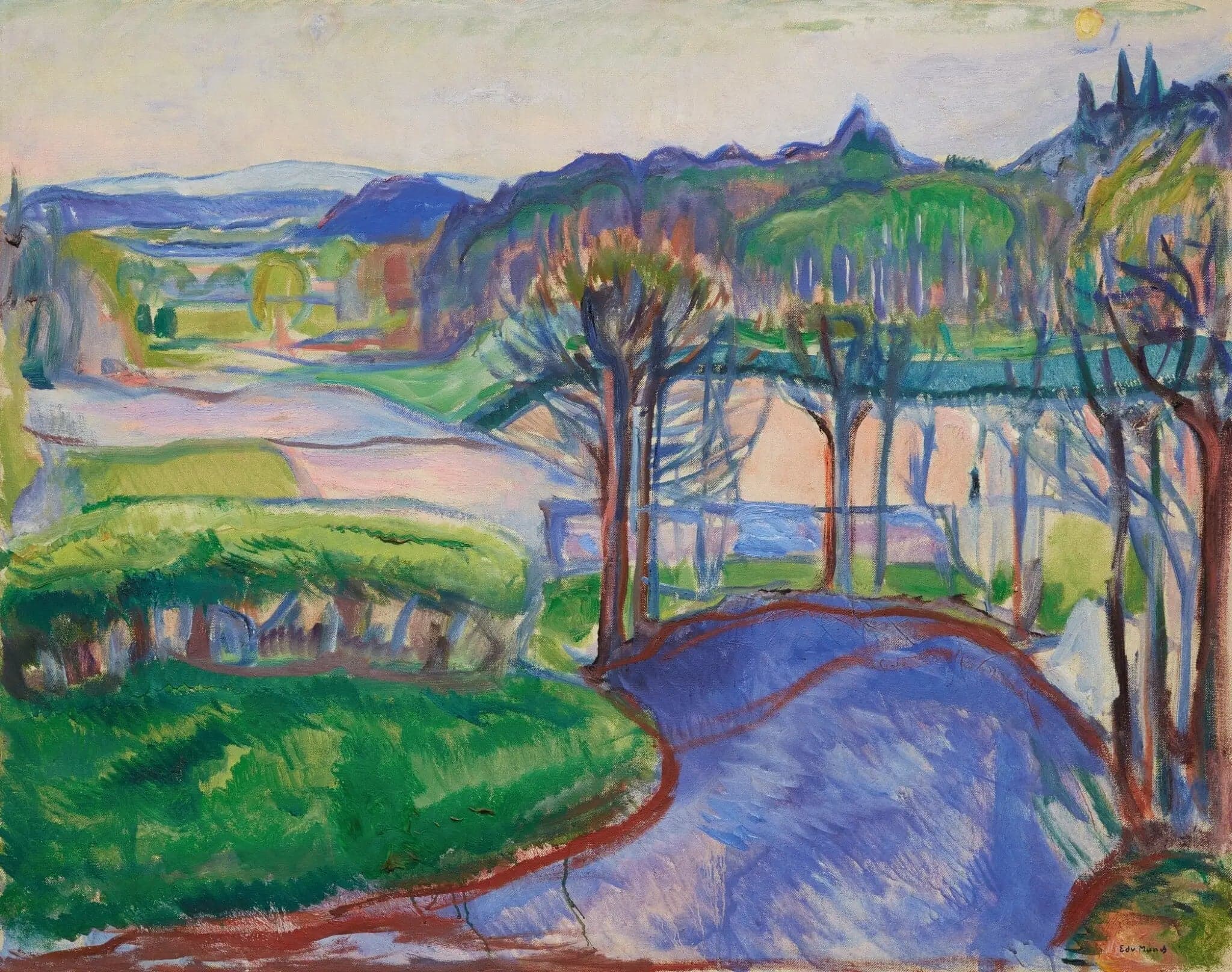
Spring Landscape
- Original dimensions
- 125.3 x 100.3 cm
- Museum
- Not specified
- Year
- 1923
Scene depicted
This canvas depicts a resilient nature, vibrant with bright colors and undulating forms, celebrating the rebirth of spring. Munch captures the brilliance of freshly bloomed flowers and the softness of sunlight, forming a harmony between sky and earth that envelops the viewer in an aura of serenity.
Historical context
This painting emblematic was born in the heart of the artistic effervescence of the 1920s. Rooted in Norwegian culture, Spring Landscape embodies Fauvism , a movement that values emotional expression through vibrant color. Although the canvas is currently unknown to the general public, its imposing dimensions give it a majestic presence worthy of a modern art gallery.
Place in the artist's career
Often seen as a turning point in Munch's career, Spring Landscape represents a transition to a more liberated expression of color and light, paralleling other major works such as The Scream and The Madonna . In each of these canvases , Munch explores universal emotions through a unique painting technique that matures over time.
Anecdote
Edvard Munch often spoke of the powerful influence of nature on his work: “The peace I found on a spring morning inspired this canvas.” This moment suspended in time, where light flourishes over a vibrant landscape, is at the heart of the emotion conveyed by Spring Landscape .