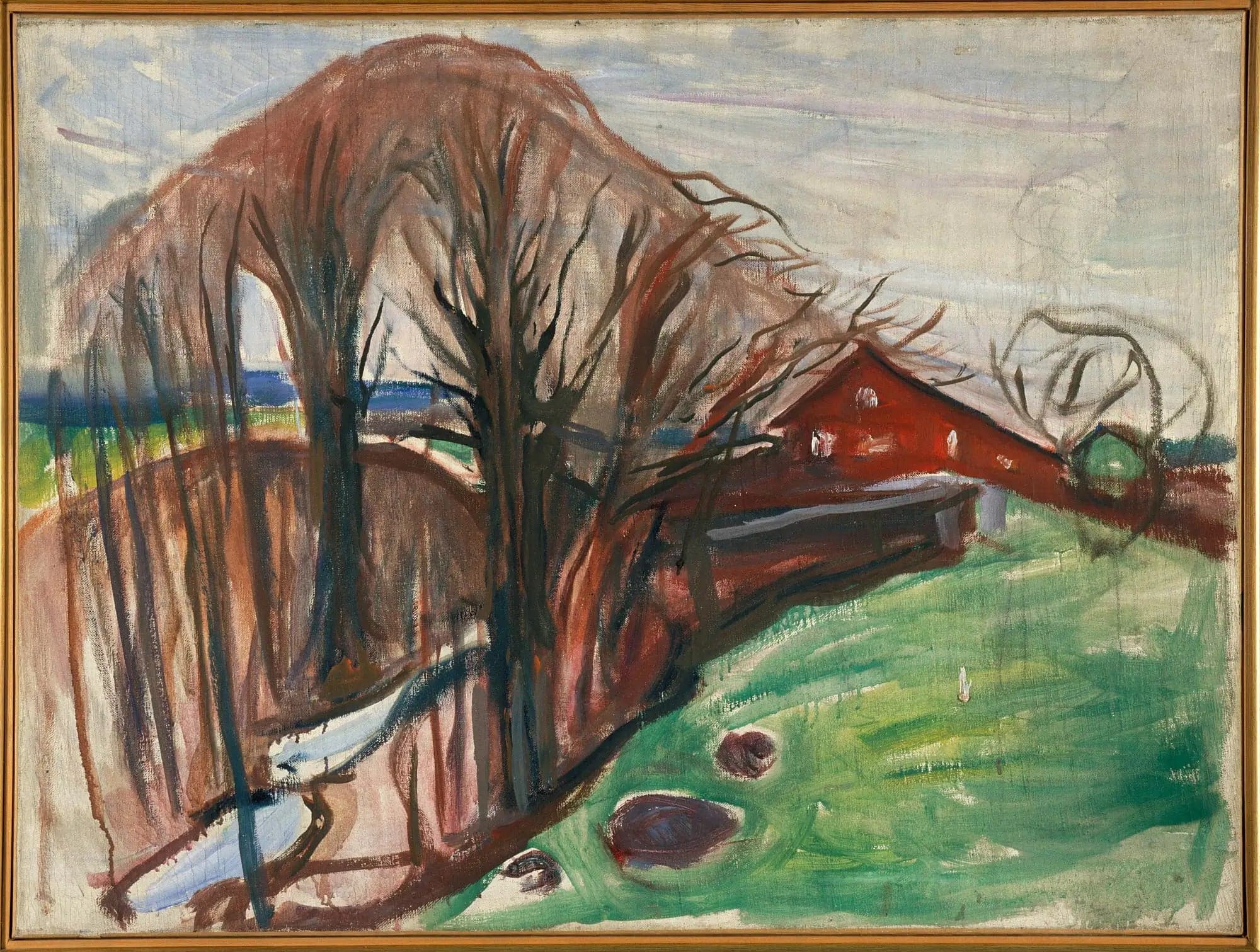
Spring Landscape at the Red House
- Original dimensions
- 90.5 x 68 cm
- Museum
- Munch Museum
- Year
- 1920
Scene depicted
The painting “Spring Landscape at the Red House” depicts a bucolic scene vibrant with life and colors, highlighting the harmony between man and nature. The iconic red house stands as a symbol of refuge, while the surrounding landscape bursts with life, inviting contemplation. Munch manages to merge realism and impressionism , delivering a personal interpretation of spring serenity.
Historical context
Created in the bucolic setting of Norway in 1920, Spring Landscape at the Red House perfectly fits into the expressionist movement of which Edvard Munch is one of the founding fathers. This period, witnessing profound social and political changes, provides the work with fertile ground for the expression of human emotions. Currently housed in the Munch Museum in Oslo, this painting evokes a dazzling spring, where nature catches its breath after winter and adorns itself with vibrant colors.
Place in the artist's career
Spring Landscape at the Red House is at the heart of Munch's career, marking a turning point towards a brighter exploration of his recurring themes. Compared to works such as The Scream and The Dance of Life , this painting offers a different perspective on his emotions, oscillating between melancholy and unbridled joy.
Anecdote
“Every painting I create is a part of my soul,” Munch reportedly said one bright morning, illustrating the emotional intensity behind each brushstroke of his masterpiece . It is in a spring atmosphere, rich with the scents of flowers and lulled by the songs of birds, that he allowed himself to be inspired to capture the ephemeral beauty of this moment.
Major exhibitions
Munch og Ekely: 1916-1944