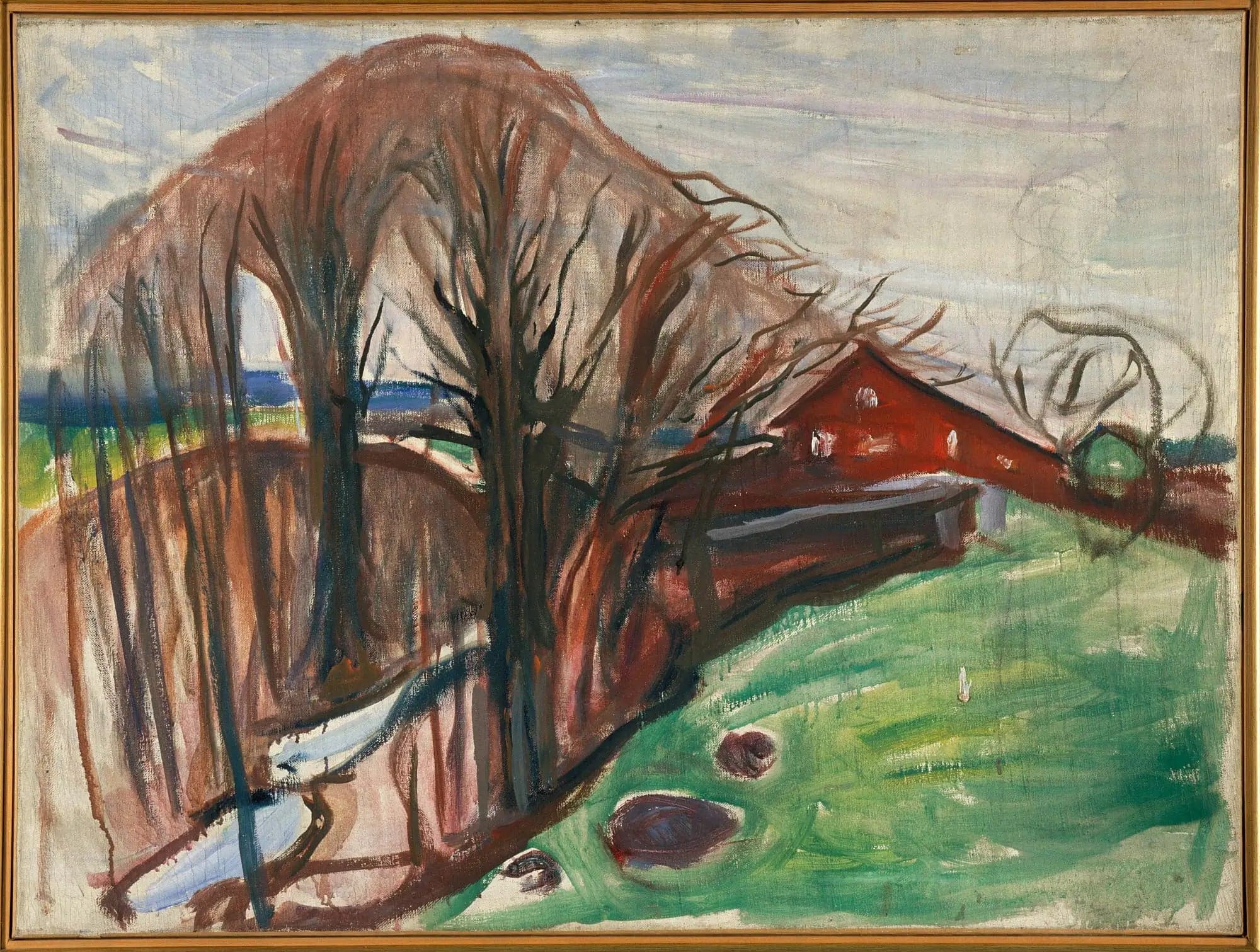
Spring Landscape at the Red House
- Original dimensions
- 125 x 101 cm
- Museum
- Munch Museum
- Year
- 1920
Scene depicted
The canvas “Spring Landscape at the Red House” offers an idyllic representation of a house nestled in the heart of a lush garden. The vibrant blooms contrast with the earthy tones of the rustic building, creating a fascinating harmony. Each brushstroke reveals not only the natural beauty but also the peaceful atmosphere that reigns in this scene, where light dances through the foliage. The red house becomes the symbol of a refuge, a vibrant space of escape filled with life.
Historical context
Created in the idyllic setting of Oslo, Norway, this painting is part of the post- impressionist period, an artistic movement that profoundly influenced Edvard Munch . In 1920, fueled by his love of landscapes and intense emotions, Munch presented the world with this canvas vibrant with colors and a spring atmosphere. Today, this work emblematic rests at the Munch Museum, where its story continues to captivate visitors.
Place in the artist's career
This painting , a symbol of a mature period for Munch, illustrates his stylistic evolution. At this time, the artist had already established his reputation with works like “The Scream” and “The Madonna,” exploring human emotions through a prism vibrant with colors and sensations. “Spring Landscape at the Red House” stands as a transitional work, where the artist combines his inner themes with a soothing outer nature.
Anecdote
“Nature whispers secrets to attentive listeners,” Munch often said, recalling his moments of inspiration. This painting may well have been conceived on a peaceful morning, when the song of birds and floral fragrances enveloped the fresh spring air, extracting from his memory the very essence of serenity and beauty.
Major exhibitions
Munch og Ekely: 1916-1944