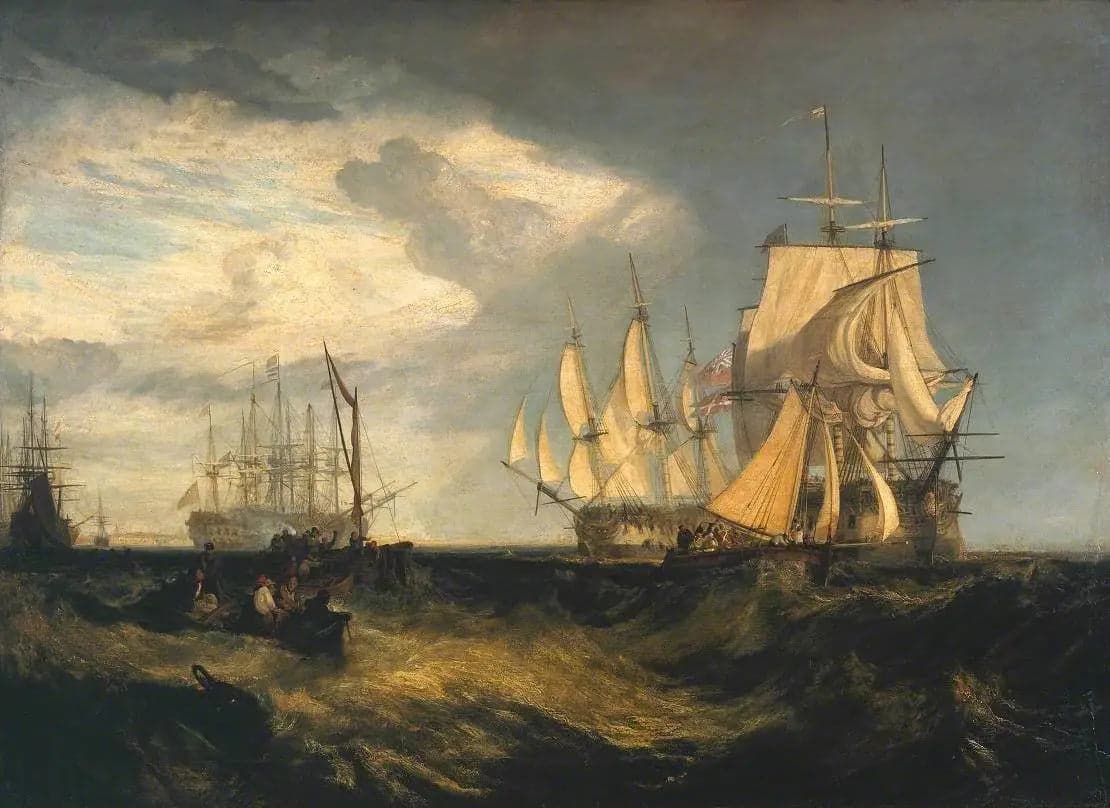
Spithead: Two Captured Danish Ships Entering Portsmouth Harbour
- Original dimensions
- 171.4 x 233.7 cm
- Museum
- Tate
- Year
- 1808
Scene depicted
This painting recounts the triumphant entry of two captured Danish ships into the port of Portsmouth, echoing a naval conflict that sealed the fate of several nations. The white sails, symbols of submission, contrast with the fervor of British sailors, paying tribute to a moment of national pride. The sea, sometimes calm, sometimes tumultuous, becomes a reflection of human emotions and historical struggles. Every element of this painting engages with the viewer, offering a striking immersion into this pivotal era.
Historical context
Created in 1808, this painting is rooted in the tumultuous context of the Napoleonic Wars. The scene unfolds in the historic port of Portsmouth, a coastal town in England, symbolizing British naval victories. Turner, a leading figure of Romanticism , captures the essence of his time through this canvas where art and military history intertwine. Today, the painting resides at the Tate , an art sanctuary in London, astonishing visitors with its majestic dimensions and masterful execution.
Place in the artist's career
Spithead stands as a milestone in Turner’s career, marking a turning point towards the exploration of light and movement. In parallel, works like The Fighting Temeraire and Rain, Steam and Speed illustrate his evolution, capturing the tumultuous atmospheres and the ephemeral beauty of the British landscape. By integrating historical elements into lyrical compositions, Turner manages to transcend his time while affirming his unique style.
Anecdote
“Light is the true character of every painting.” Thus spoke Turner, reflecting on his radical approach to painting . One April morning, on the shores of Portsmouth, he observed the magnificent captured Danish ships, illuminated by the golden light of the rising sun, a spectacle that inspired this vibrant work of art . Through Spithead , he transcribes not only a scene but also an emotion, a moment suspended in time, imbued with maritime grandeur.