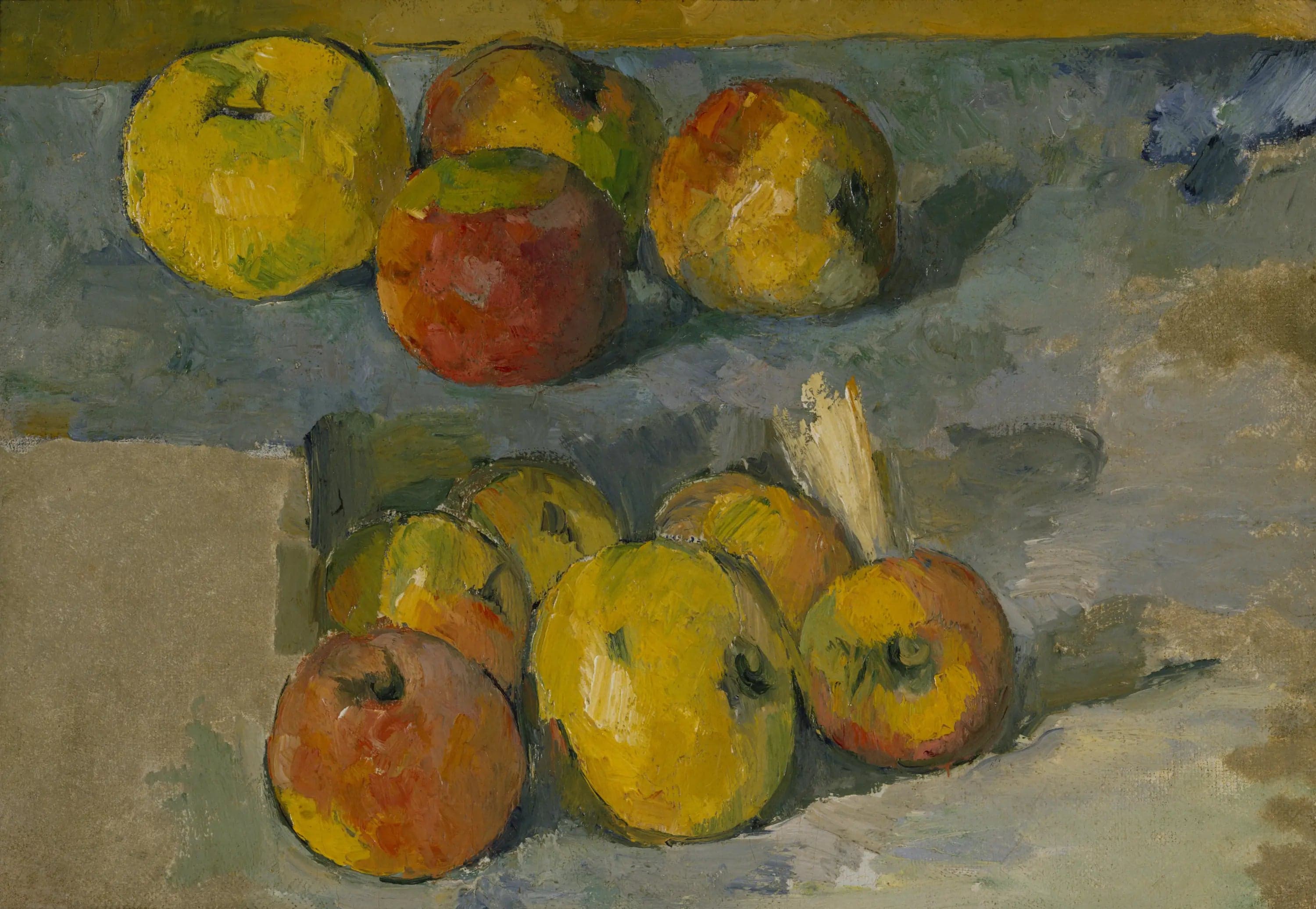
Some Apples
- Original dimensions
- 23 x 18 cm
- Museum
- Langmatt Museum Sidney and Jenny Brown Foundation
- Year
- 1879
Scene depicted
This canvas captivates by revealing a set of apples with sobriety, unveiling so much complexity in simplicity. The fruits, like silent witnesses, carry the ambient light surrounding them, creating a perfect balance between color and form. Cézanne invites us to feel the texture and dimension of the apples, creating a dialogue between the objects and the viewer, often experienced as a harmonious ballet of light.
Historical context
Created in 1879, this painting emblematic of Paul Cézanne emerges in the vibrant context of French Impressionism , in Aix-en-Provence. Cézanne, a pioneer of the transition to modernism, transforms the gaze upon nature through his unique eye. Today, this precious work is located at the Langmatt Museum Sidney and Jenny Brown Foundation in Switzerland, where it continues to captivate art lovers with its delicate dimensions of 23 x 18 cm that evoke an intimate closeness.
Place in the artist's career
Some Apples is part of a decisive turning point in Cézanne's career, marking his arrival in a mature style imbued with authenticity. Compared to other works such as The Montagne Sainte-Victoire and The Card Players , we discern a technical evolution: his exploration of forms and perspectives touches on emotional depth, attesting to his exceptional genius.
Anecdote
“I want to encase nature in a canvas , where each apple becomes a visual melody.” This quote from Cézanne resonates particularly when evoking the inspiration behind his masterpiece. Imagine a spring morning, where soft rays illuminate a simple corner of a table, highlighting apples resting peacefully. It is in this everyday scene that the artist captures a pure emotion, transformed into painting .