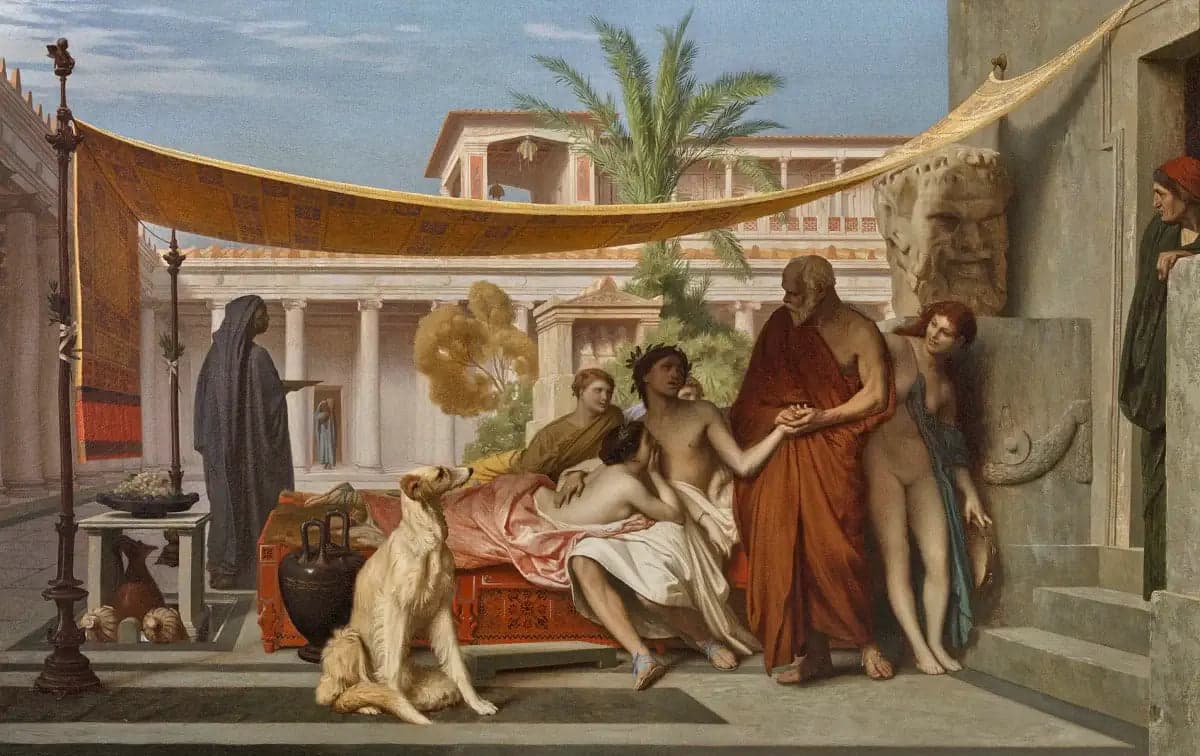
Socrates searching for Alcibiades in the house of Aspasia - Jean
- Original dimensions
- 35.5 x 23 cm
- Museum
- Raclin Murphy Museum of Art
- Year
- 1861
Scene depicted
In this captivating painting , Gérôme depicts a scene imbued with dramatic tension, where Socrates, an emblematic figure of philosophy, seeks his disciple Alcibiades in the house of Aspasia, a famous courtesan of the time. This composition immerses us in a silent yet rich dialogue, where the gestures and expressions of the characters reveal the depth of their relationship, full of intellectual and emotional nuances.
Historical context
Created in 1861 and taking place in the prestigious setting of the Raclin Murphy Museum of Art, this painting is a major work by Jean-Léon Gérôme , representing the movement of realism academic . In an atmosphere bathed in soft light, this painting evokes a time when intellect and art intertwined in the vibrant city of Athens, immersing the viewer in a fascinating interaction between Socrates and Alcibiades.
Place in the artist's career
Socrates Seeking Alcibiades in the House of Aspasia marks a turning point in Gérôme's career, testifying to his stylistic peak. At a crossroads, this painting fits into a lucid heritage, echoing other works like The Slave Market and Truth Coming Out of the Well , illustrating a progression in psychological depth and the richness of the master's colors.
Anecdote
Jean-Léon Gérôme once stated: “Beauty lies in the transgression of the ordinary through art,” evoking a passion that guided him throughout the creation of his works. One sunny afternoon, while wandering the quiet streets of Paris, he was inspired by the desire to capture the complexity of the human soul. It is this same energy that nourished the evocative power of his iconic painting , Socrates Seeking Alcibiades in the House of Aspasia .