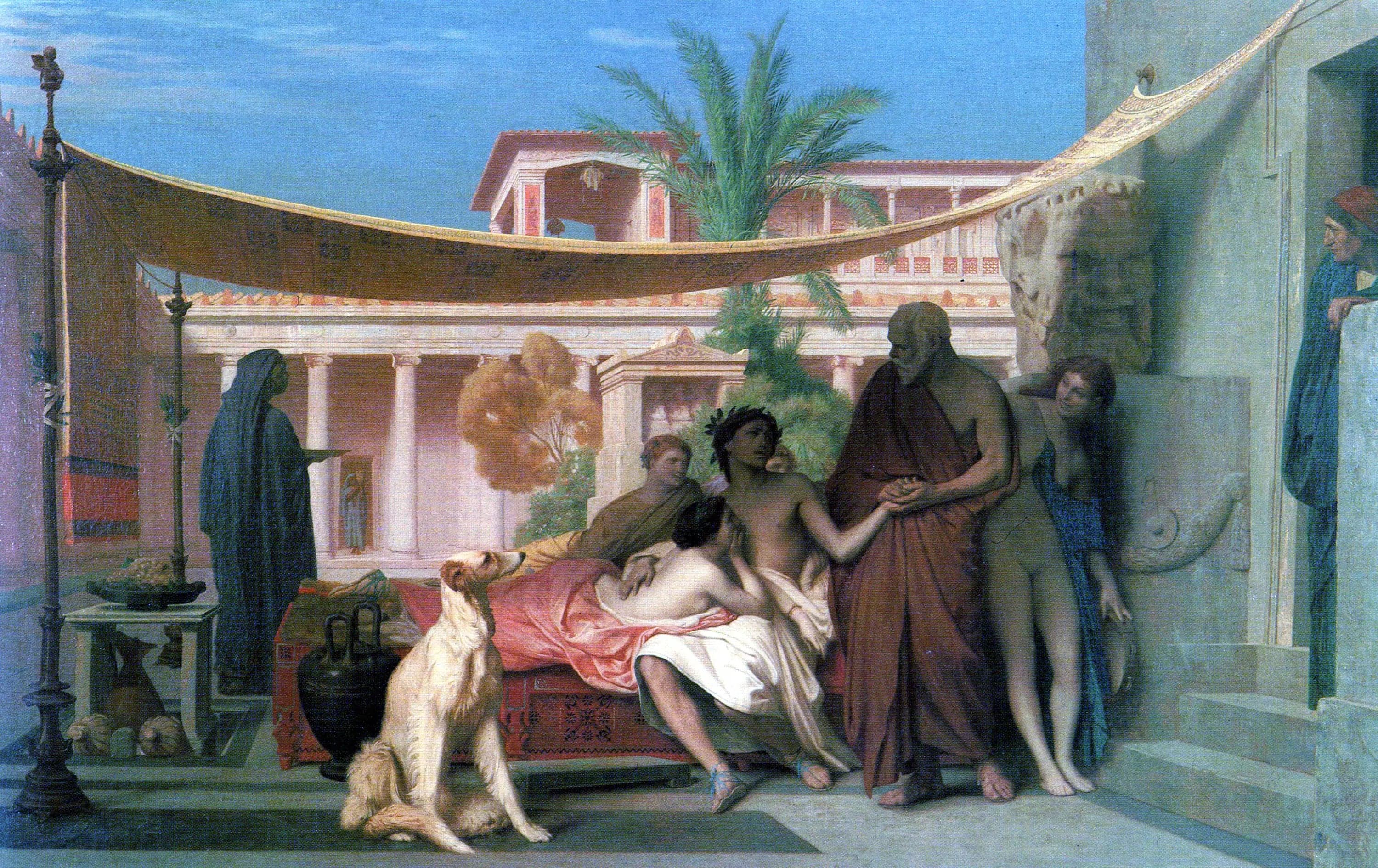
Socrates coming to Alcibiades at Aspasia's to seek - Jean
- Original dimensions
- 97.2 x 63.8 cm
- Museum
- Not specified
- Year
- 1861
Scene depicted
In this canvas , we witness a captivating scene where Socrates, an emblematic figure of philosophy, meets Alcibiades, an ambitious young man. The palpable tension creates an atmosphere rich in emotions, revealing the complexity of human relationships. Aspasia, an educated and charismatic woman, stirs the canvas with a vibrant array of dialogues and thoughts. Gérôme, with impeccable mastery, transports us to this era where culture blossoms under the critical gaze of the wise.
Historical context
Created in 1861, this painting emblematic of the academic movement finds its origin in a context where classical art and realism intertwine in a creative dance. Jean-Léon Gérôme , undisputed master of his time, managed to capture the essence of Greek philosophy through his canvas . At that time, Paris was the beating heart of art, attracting artists from all backgrounds. Currently, the canvas is kept in a private collection, but it will surely be showcased in future exhibitions. Its dimensions, 97.2 x 63.8 cm, give it a majestic presence.
Place in the artist's career
Socrate venant Alcibiade chez Aspasie chercher represents a high point in Gérôme's career. This canvas fits into a period of maturity in his style, illustrating a shift towards more narrative compositions. Alongside other works like "Combat de coqs" and "La danse de Salomé," it becomes evident that Gérôme is evolving towards more complex representations, combining both technique and philosophical content.
Anecdote
“Art is the purest expression of the soul,” said Gérôme. It was on a bright spring morning, as he wandered through the streets of Paris, that he found inspiration for this masterpiece . The soft murmurs of passersby, the scent of blooming flowers, all nourished the vision of the canvas . This moment of intense creativity breathed life into the painting , giving it an unforgettable emotional depth.
Major exhibitions
Salon of 1861