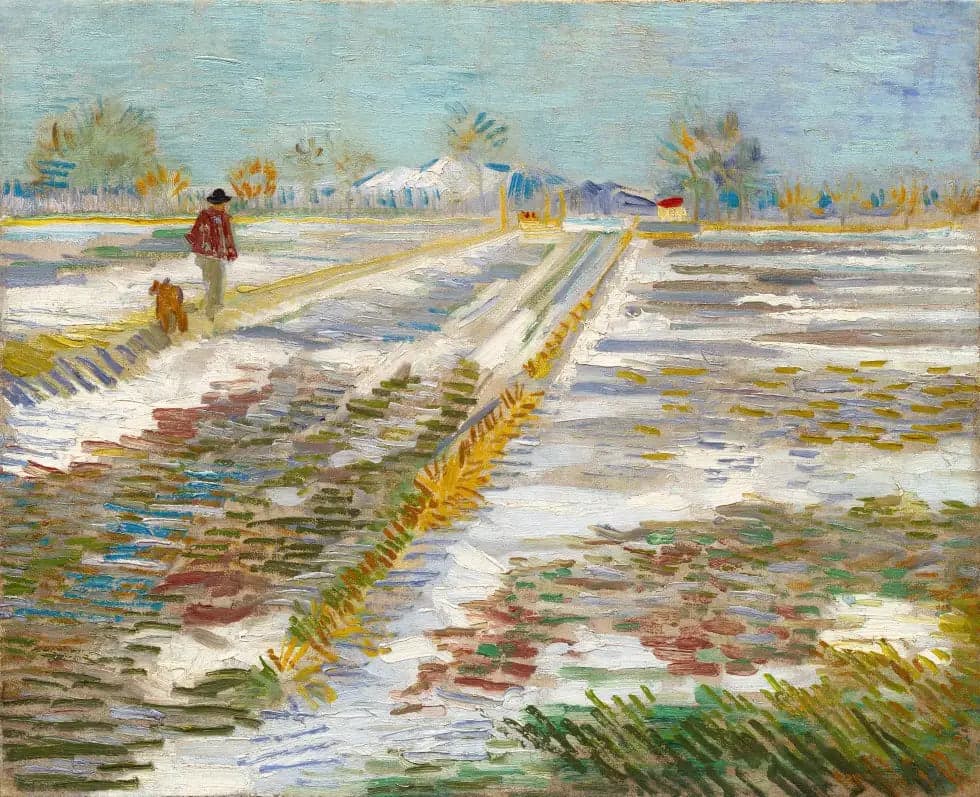
Snowy Landscape
- Original dimensions
- 46 x 38 cm
- Museum
- Solomon R. Guggenheim Museum
- Year
- 1888
Scene depicted
The painting “Snowy Landscape” captures the precious moment of a winter landscape , where solitary trees rise majestically under a deep blue sky, while the snow spreads an immaculate carpet on the ground. The scene evokes a soothing silence, a serenity unique to winter, where nature rests, asleep under its blanket of flakes.
Historical context
Created in 1888 in Arles , this iconic painting is at the heart of Post-Impressionism , an artistic movement that revolutionizes the perception of light and color. The painting is currently exhibited at the Solomon R. Guggenheim Museum, testifying to its importance in the history of art.
Place in the artist's career
“Snowy Landscape” represents a fascinating stage in Van Gogh's career, demonstrating his growing mastery of color and light. This masterpiece can be compared to “ Starry Night ,” where the artist's inner turmoil blends with dreamlike visions, as well as to “ The Sunflowers ,” which celebrates life and vibrant color. Here, the canvas illustrates his quest for harmony through the contrast between the brilliant whiteness of the snow and the depth of the skies.
Anecdote
“Light is a living painting, a poem that I capture with my brushes,” Van Gogh might have said while painting this masterpiece. The idea of capturing the fleeting essence of a landscape under the snow must have appeared to him on a cool morning, as he admired the world wrapped in a white cloak, revealing the poetic strength of winter.