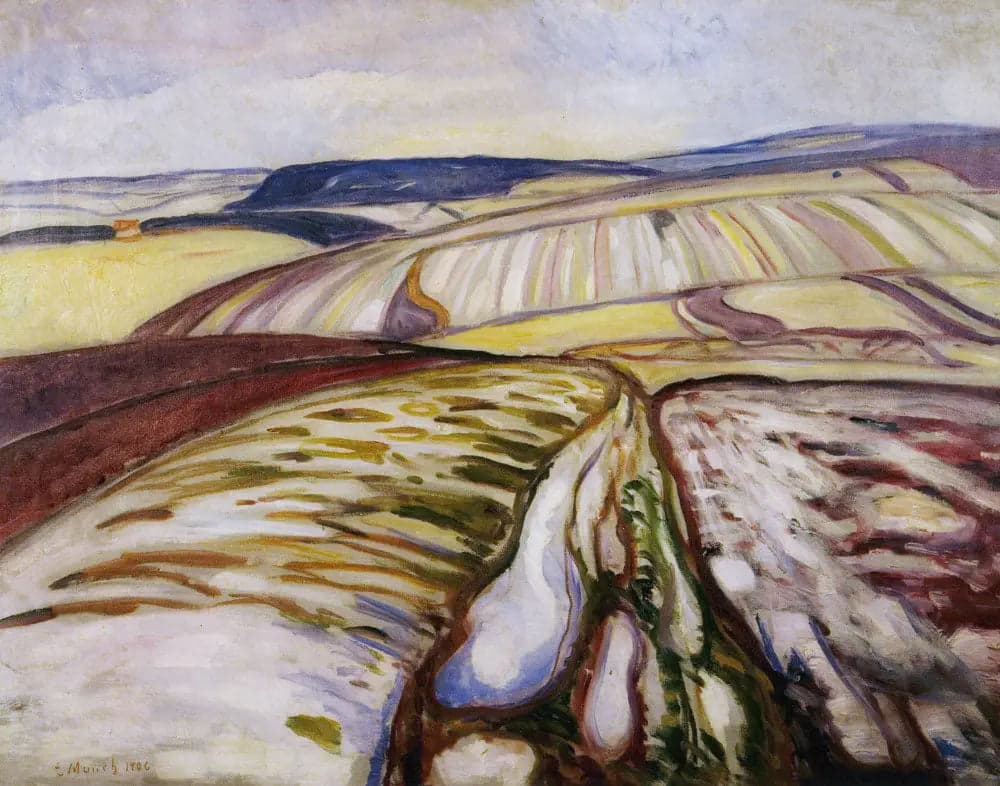
Snowy Landscape, Thuringia
- Original dimensions
- 91 x 71 cm
- Museum
- Von-der-Heydt Museum
- Year
- 1906
Scene depicted
In this painting, Munch offers us a fairy-tale panorama where the snow envelops the landscape in a silent softness. The trees, majestic and majestically frozen in their winter sleep, seem to merge into a pearly gray sky, creating an atmosphere of calm and serenity. Each brushstroke intensifies the feeling of isolation, plunging the viewer into a contemplative meditation, thus revealing the very soul of winter.
Historical context
Created in 1906, the painting "Snow Landscape, Thuringia" by Edvard Munch embodies the essence of the expressionist movement. Located in the heart of Thuringia, this canvas is set in a time when art seeks to express deep emotions through meaningful natural landscapes. Today, this iconic work is displayed at the Von-der-Heydt Museum , a reference for art lovers, with dimensions that highlight the delicacy of details and the intensity of artistic expression.
Place in the artist's career
"Snow Landscape, Thuringia" represents a key period in Edvard Munch's career, marking his evolution towards expressionism . Comparable to other paintings such as "The Scream" and "The Dance of Life," this canvas reveals a deep sensitivity to nature. Here, it symbolizes a stylistic maturation, blending rigorous technique and raw emotion that define the artist's journey.
Anecdote
Edvard Munch once said: "Nature not only reveals beauty, it also conveys melancholy." On a peaceful snowy morning, the artist felt the echo of winter silence, an essential inspiration for this masterpiece . The evocative power of this painting testifies to the intimate connection between the artist and the landscape, a continuous dialogue between man and nature.