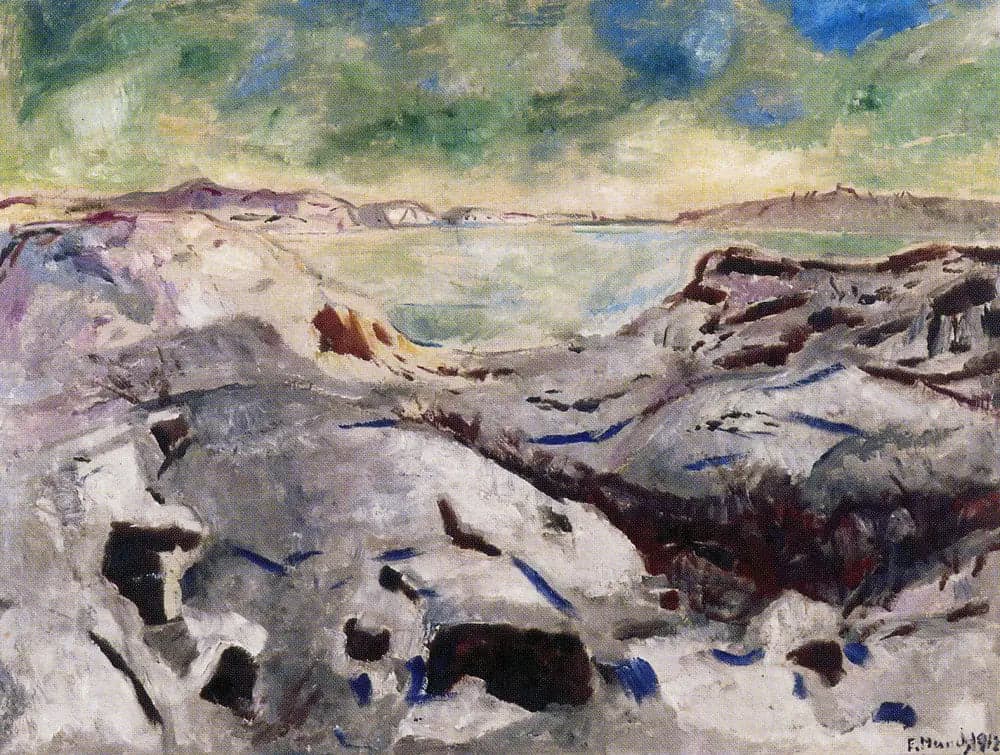
Snowy Landscape at Kragerø
- Original dimensions
- 110.5 x 80 cm
- Museum
- Not specified
- Year
- 1912
Scene depicted
In the canvas “Snow Landscape in Kragerø,” Edvard Munch offers us an introspective view of the icy beauty of Norwegian landscapes. The composition evokes an almost palpable tranquility, where cool blue tones blend with shades of bright white, embodying an almost sacred silence. The artist seems to invite us to meditate on winter, buried memories, and the ephemeral beauty that surrounds it.
Historical context
Created in 1912, this painting embodies its roots in the picturesque setting of Kragerø, a charming coastal town in Norway. Edvard Munch , a prominent figure of the expressionist movement, captures the essence of this era through his canvas . This masterpiece, not located in a specific museum, belongs to the history of modernism and embodies the artistic quest for a strong inner world, while playing on the tones of nature.
Place in the artist's career
This painting reveals a crucial phase in Munch's career, marking a transition towards artistic maturity. Alongside works such as “The Scream” and “The Madonna,” “Snow Landscape in Kragerø” testifies to a technical and emotional evolution, where sensitivity to light and color becomes central, propelling the viewer into a universe of deep feelings.
Anecdote
Munch once stated: “Nature is my canvas, and my painting is its reflection.” This inspiration was born on a pristine morning when the snow covered the familiar landscapes with its soft mantle, awakening in him a soothing melancholy. It is this dreamlike and solitary atmosphere that infuses the masterpiece with depth and emotion.