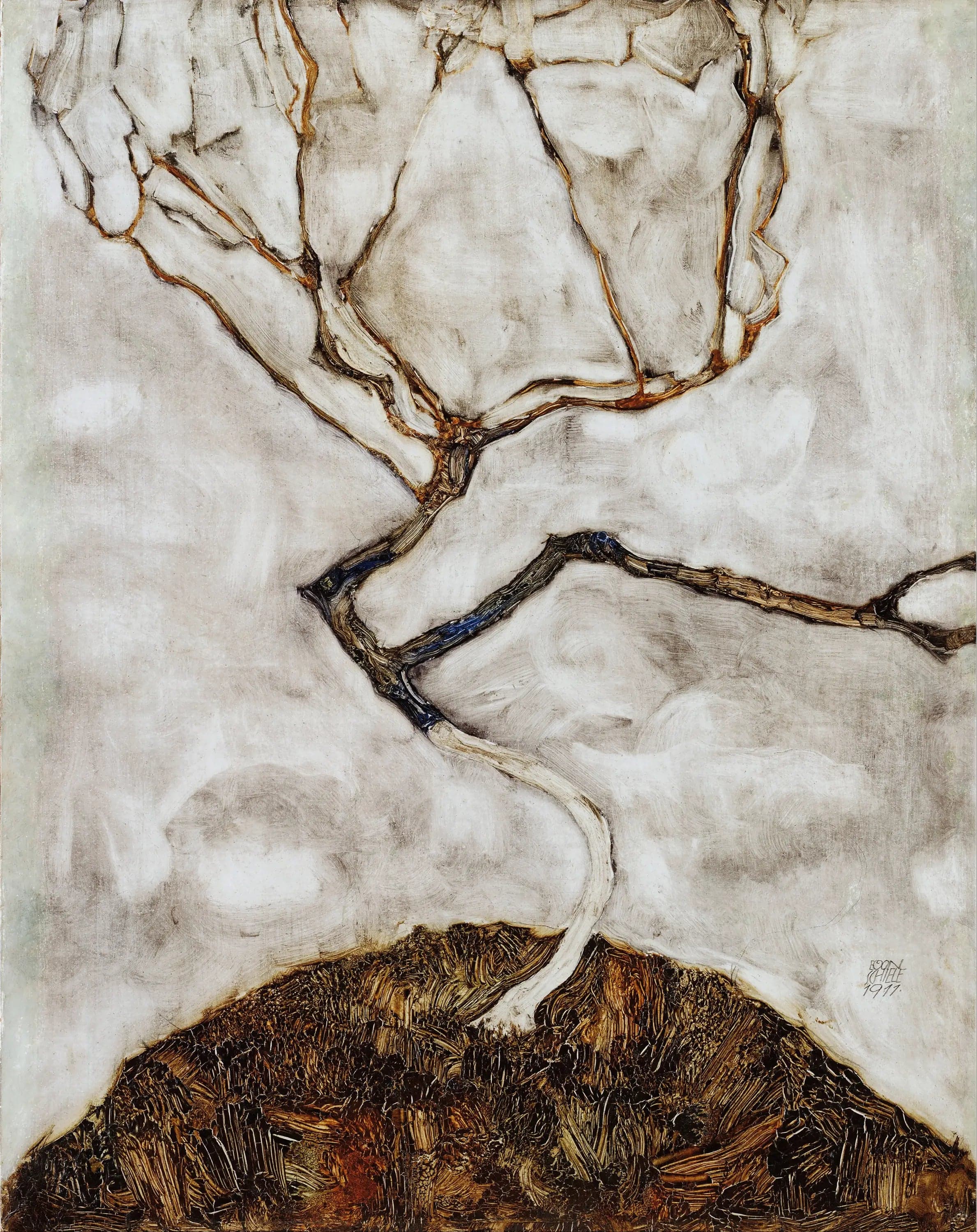
Small Tree at the End of Autumn
- Original dimensions
- 335 x 420 cm
- Museum
- Leopold Museum
- Year
- 1911
Scene depicted
In this pictorial work , an elegant tree stands against an orange sky, its bare branches revealing a poignant emptiness. Every detail is laden with symbolism , evoking both the ephemeral beauty of autumn and the brutal reality of time passing, a theme dear to Schiele. The artist manages to capture the depth of this transitional season, where the light of a late day illuminates the contours of a nature about to withdraw.
Historical context
Created in 1911, in the vibrant artistic momentum of Vienna, Petit arbre à la fin de l'automne is at the heart of Expressionism , a powerful and innovative movement. Egon Schiele , an iconic figure of this era, transposes the intensity of his emotions onto his canvas , while drawing inspiration from the Austrian landscapes that surround him. Currently exhibited at the Leopold Museum in Vienna, this majestic painting , with its impressive dimensions, bears witness to a time of unprecedented artistic creativity.
Place in the artist's career
Petit arbre à la fin de l'automne represents a pivotal moment in Schiele's career. After a period of training, this painting embodies his unique style, where raw emotion meets refined technique. In parallel, other works such as Self-Portrait with a Palette and The Family reveal his artistic evolution, combining introspection and stylistic boldness.
Anecdote
“Nature is my reflection, and every tree has a story to tell,” Schiele confided during an inspiring walk through the forests of Austria. A young artist with a tormented soul, he found in a simple tree at dusk a metaphor for his existence, accentuated by the melancholic aura of the painting and the echo of falling leaves, mirroring his own emotional journey.