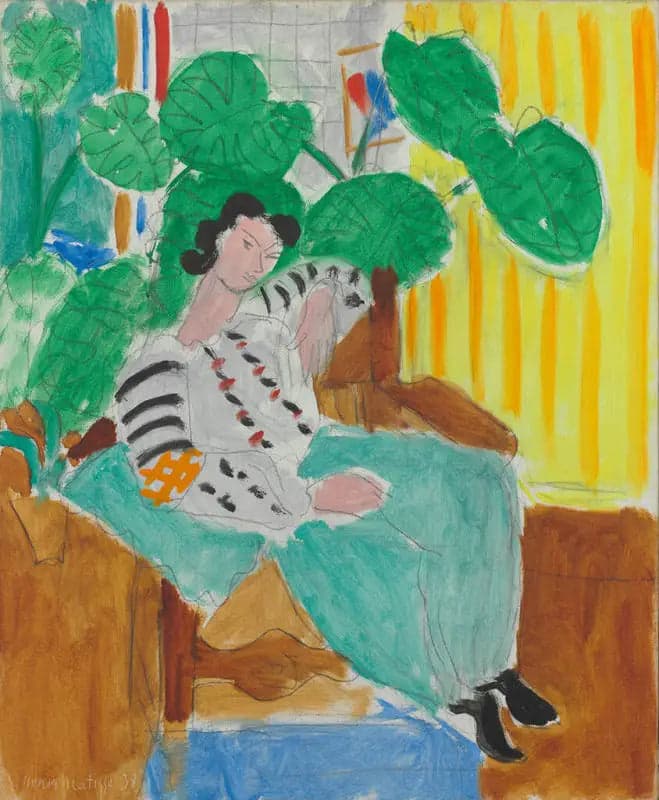
Small Romanian Blouse with Foliage
- Original dimensions
- 38.1 x 46 cm
- Museum
- Baltimore Museum of Art
- Year
- 1937
Scene depicted
This painting evokes the beauty of traditional costumes, wrapped in lush foliage. The central character, adorned in a colorful blouse, seems to dance with nature, merging both with the plant world and her cultural history. Every detail of this composition tells a story, paying tribute to the richness of traditions and the simplicity of daily life.
Historical context
Created in 1937, this painting is part of the Fauvist movement, characterized by a bold use of colors and a non-conformist style. In Baltimore, at the art museum, this work proves to be a vibrant testimony of a time when artistic experimentation was at its peak. We dive here into a dazzling world, where each brushstroke escapes the conventions of representation.
Place in the artist's career
“Petite Blouse roumaine au feuillage” is one of the milestones of Matisse's career, illustrating his maturity period where he successfully integrated folkloric elements into his bold vision of art. Alongside “The Dance” and “The Joy of Life,” this masterpiece testifies to an evolution towards the celebration of color and movement, showcasing his influences and mastery of painting.
Anecdote
Henri Matisse once declared: "Color is my life, my reason for being." This painting was inspired one spring morning when he encountered a woman wearing a traditional blouse in a sunny alley. The vibrant energy of that moment is palpable in the expressive strength of the canvas and echoes his passion for chromatic harmony.