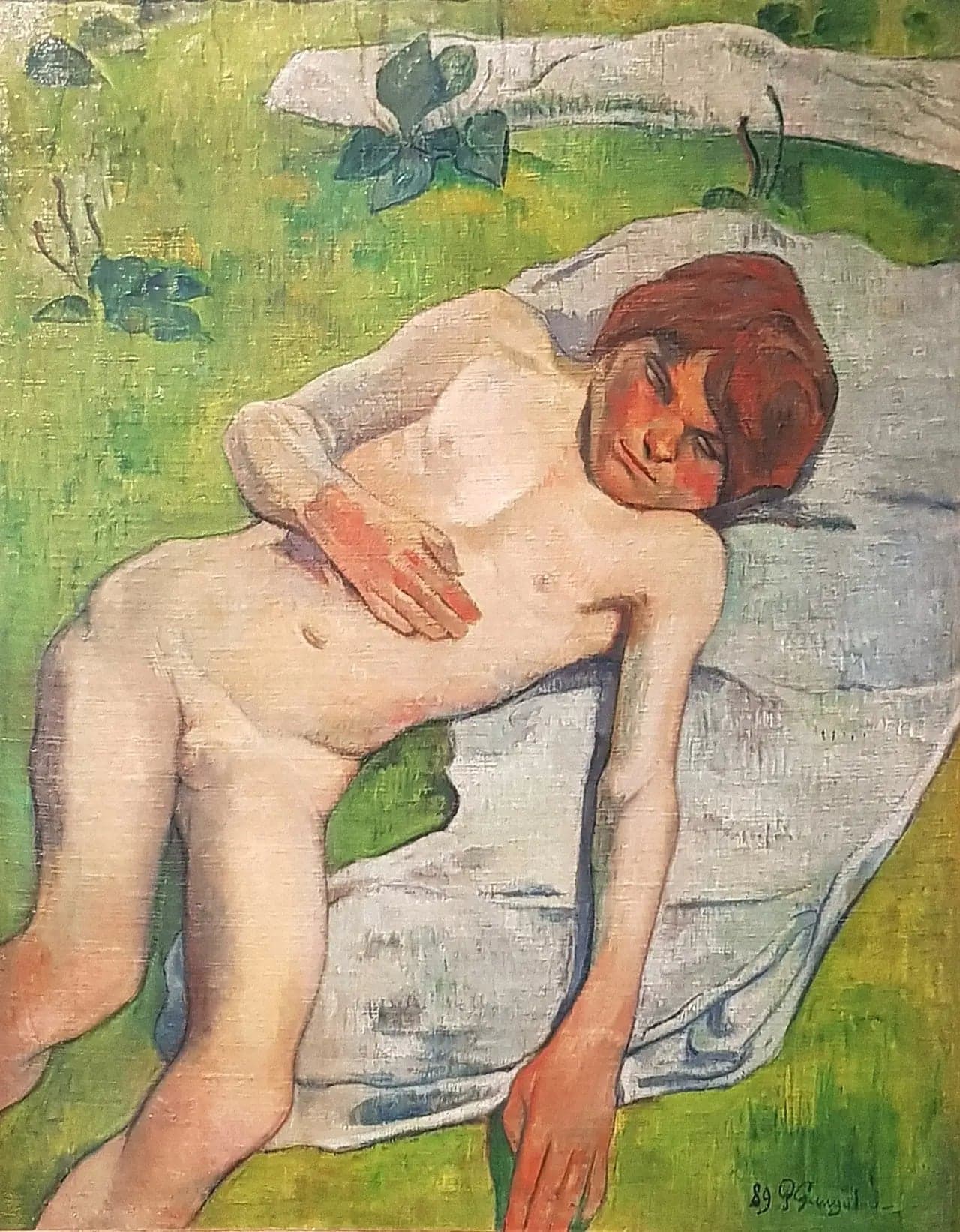
small naked Breton
- Original dimensions
- 73.5 x 93 cm
- Museum
- Wallraf-Richartz Museum
- Year
- 1889
Scene depicted
In this painting , a young naked Breton, full of innocence, stands on the beach, bathed in the soft sunlight. The play of shadow and light in his environment evokes a tranquil atmosphere, offering an introspective look at childhood. The forms are stylized, revealing Gauguin's sensitivity to the theme of nature and childhood, turning away from modernity to celebrate authenticity.
Historical context
Created in 1889, this painting emblematic of Paul Gauguin finds its roots in the heart of Pont-Aven, Brittany. This painting is part of the Nabis movement, whose approach aims to express emotions through vibrant colors and simplified forms. Today, the painting resides at the Wallraf-Richartz Museum in Cologne, where visitors can admire its impressive dimensions of 73.5 x 93 cm.
Place in the artist's career
This painting , “petit breton nu,” represents a pivotal period in Gauguin's career, marking his exploration of themes of escape and simplicity. In parallel, the paintings “Vision after the Sermon” and “The Nap” illustrate the evolution of his style. This painting testifies to his artistic maturity, where vibrant colors and bold forms intertwine to create a dreamlike world.
Anecdote
“Life is a dream from which we must awaken through art.” These words from Gauguin resonate with the magic of his creative process. Imagine him, one spring morning, absorbed by the beauty of a young Breton, observing him in the gentle whisper of the sea breeze. It is this fleeting moment that inspired this pictorial work , capturing the innocence and serenity of childhood.