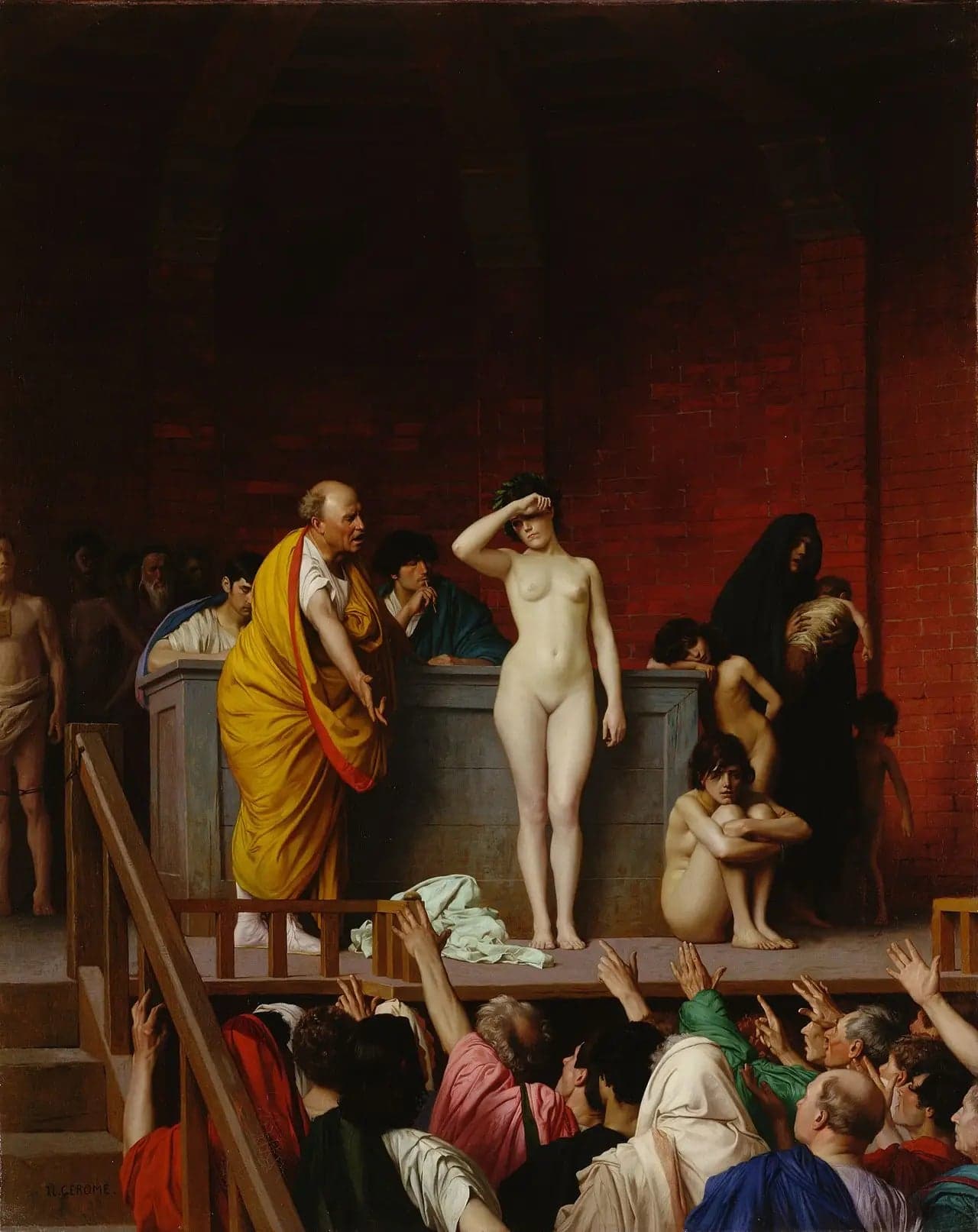
Slave Sale in Rome - Jean
- Original dimensions
- 74 x 92 cm
- Movement
- Academicism
- Museum
- Hermitage Museum
- Year
- 1884
Scene depicted
“Sale of Slaves in Rome” depicts a heartbreaking situation, where men and women are offered as goods in a market of another time. The work accurately illustrates the tragic tableau of the human condition, exacerbated by the harsh light that highlights the anguish on the faces of the captives. Each character tells a story; their expression is a reflection on the limits of power and freedom.
Historical context
Created in 1884, the painting “Sale of Slaves in Rome” is an emblematic work of the academic movement , representing a period of great historical intensity. Jean-Léon Gérôme , a renowned artist, excelled in the art of capturing evocative moments. Today preserved at the Hermitage Museum , this canvas , measuring 74 by 92 centimeters, immerses us in the stark reality of past Roman practices.
Place in the artist's career
This painting is part of a series of significant works, marking the peak of Gérôme's career. The precision and emotional intensity of this canvas resonate with other achievements such as “Pollice verso” and “The Dance of Dust,” marking his stylistic and technical evolutions over the years. This period symbolizes the turn towards a more complex and nuanced aesthetic.
Anecdote
Jean-Léon Gérôme once whispered: “Each painting is a window into an ephemeral world, an invitation to reflection.” It was while wandering through the tumultuous markets of Rome, rocked by the cries of merchants and the scents of spices, that he found inspiration for his masterpiece . The evocative power of the canvas rests on this deep connection to the humanity of the scenes he captured.