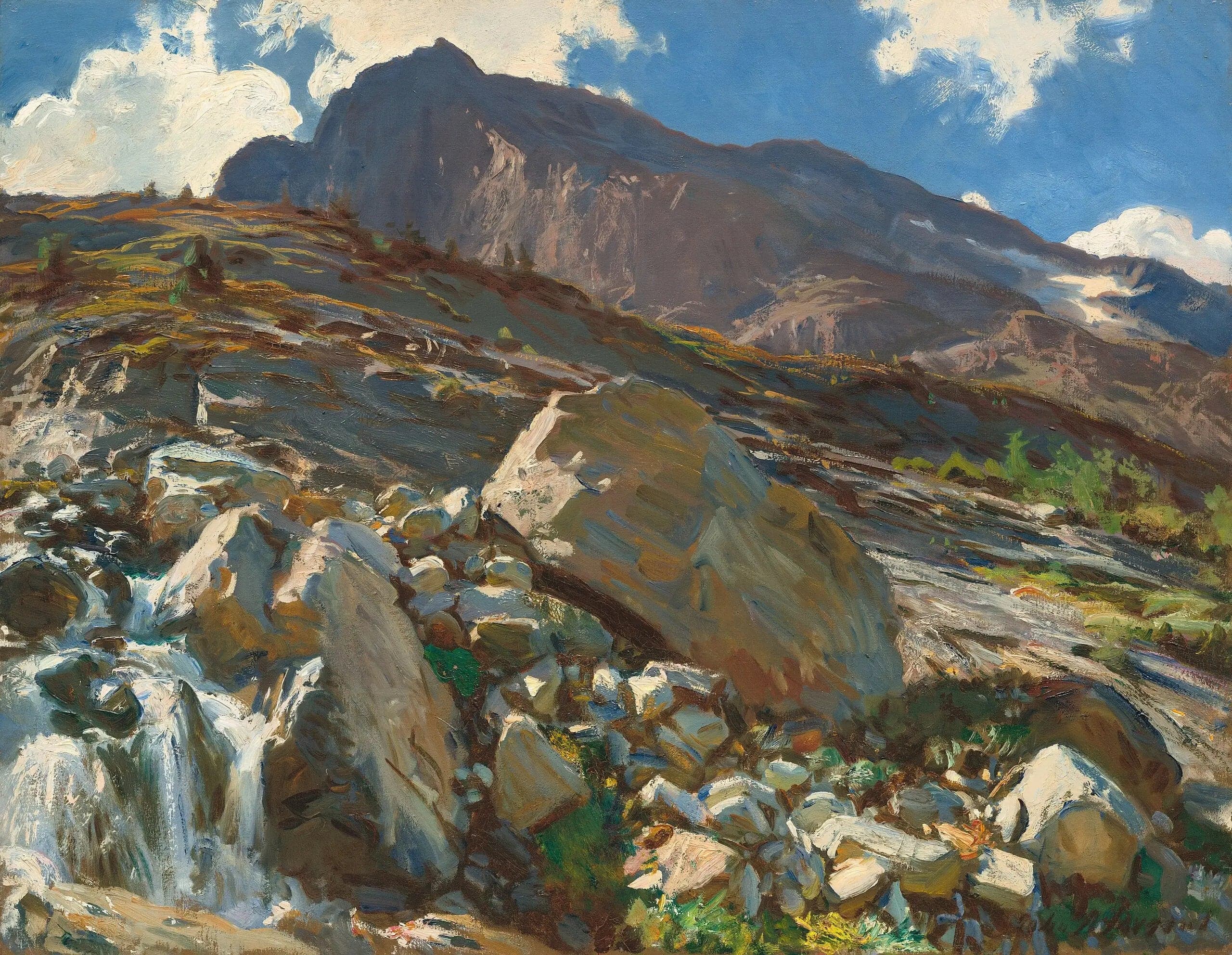
Simplon Pass
- Original dimensions
- 92.6 x 71.8 cm
- Museum
- National Gallery of Art
- Year
- 1911
Scene depicted
"Col du Simplon" depicts a majestic landscape where the mountain peaks stand proudly against a pure blue sky. The subtle shades of the painting highlight the multiple hues of greenery and the play of light, making this artwork a celebration of natural beauty. The peaceful atmosphere emanating from the scene invites the viewer to a contemplative meditation.
Historical context
Created in 1911, "Col du Simplon" is set in a fascinating alpine setting, embracing the wild beauty of the Swiss mountains. This painting belongs to the Impressionist movement, a time when the artist Sargent was able to capture bright light and natural atmospheres. The canvas is currently displayed at the National Gallery of Art , an iconic place in Washington D.C., celebrating the fusion of art and nature.
Place in the artist's career
This canvas is at the crossroads of Sargent's career, marking a period of artistic maturity. Compared to his famous "Portrait of Madame X" and "Carnation, Lily, Lily, Rose," "Col du Simplon" reveals the evolution of his pictorial approach, oscillating between palpable reality and emotional expression.
Anecdote
"Art is a world where the soul escapes," Sargent might have said while contemplating the majestic setting of the Simplon at sunrise. That morning, the mountains still veiled in mist inspired a soft and mystical light, a illumination sublimely captured in his canvas .