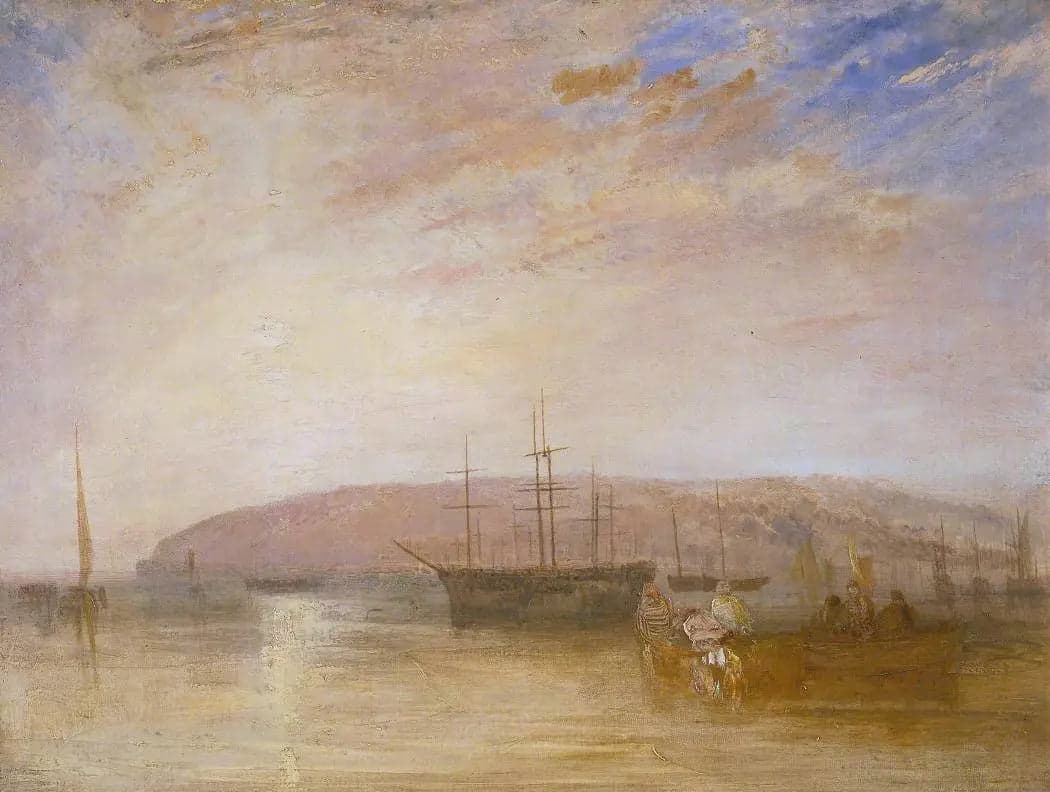
Shipping off East Cowes Headland
- Original dimensions
- 46 x 60.3 cm
- Museum
- Tate
- Year
- 1827
Scene depicted
In this composition , Turner illustrates a fleeting moment of maritime life, where sailing boats are approaching the tranquil port of Cowes. The tumultuous clouds blend with the shimmering reflections of the water, capturing a fluid drama between humanity and the sea. The agitation of the waves contrasts with the fleeting serenity of the boats, creating a vivid tension that invites us to dive into the depths of this canvas .
Historical context
Created in 1827, this iconic painting by Joseph Mallord William Turner is set in the maritime framework of the coastal town of Cowes, on the Isle of Wight. A true reflection of the romantic era, this canvas is part of the artistic movement that emphasizes light and nature, capturing the essence of the pre-Victorian age. Currently exhibited at the Tate , this sumptuous pictorial work measures 46 x 60.3 cm and transports us into a universe where the sea merges with infinity.
Place in the artist's career
This painting is part of a pivotal period in Turner's career, marking a stylistic maturity where he explores the effects of light more boldly. It parallels works such as The Fighting Temeraire and Rain, Steam and Speed , illustrating his technical innovation and growing mastery in the use of color and light.
Anecdote
Turner, with his passion for the movement of waters, once stated: “The sea is a mirror of the human soul, and each wave an emotion to explore.” It is this quest for connection between nature and emotion that permeates the painting Shipping off East Cowes Headland , conceived during a foggy morning where the oppressive atmosphere hinted at the magic of British skies.