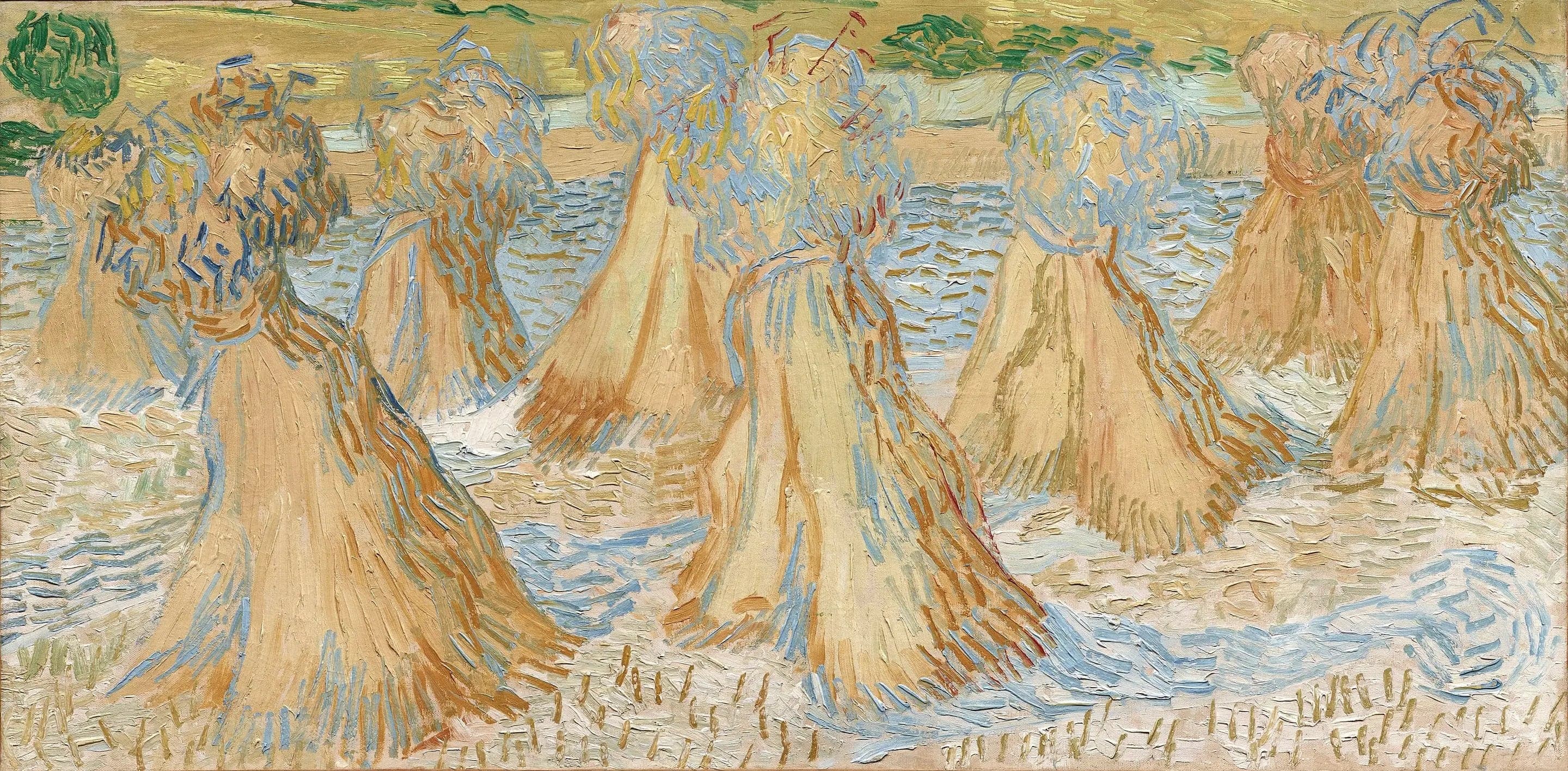
Sheaves of Wheat
Scene depicted
This painting depicts a field of wheat swaying in the gentle breeze, dotted with golden sheaves. The composition pays tribute to the simple yet powerful beauty of the countryside, a celebration of nature and the vital force emanating from the fields stirred by the wind. The viewer's gaze is immediately drawn to the abundance of wheat and the silent poetry that emanates from it.
Historical context
Created in 1890, the iconic painting Wheat Sheaves by Vincent van Gogh reflects a significant period in art history, Post-Impressionism . This pictorial work was created in Auvers-sur-Oise , a small French commune that became famous thanks to the artist. Today, this valuable painting is preserved at the Dallas Museum of Art , measuring 100.96 x 50.5 cm, showcasing the artist's great mastery.
Place in the artist's career
The canvas Wheat Sheaves represents a turning point in Van Gogh's career, a manifesto of artistic maturity. Following iconic works like The Starry Night and The Sunflowers , this painting illustrates the artist's unconditional love for life and nature, thus showing his technical evolution towards renewed expressiveness.
Anecdote
“Nature is a true mirror of the soul,” Van Gogh might have expressed as he stood, inspired, in the golden wheat fields on a sunny summer morning. The canvas Wheat Sheaves evokes this perfect feeling of love for nature, capturing the moment when the artist absorbs the soft light and vibrant colors.