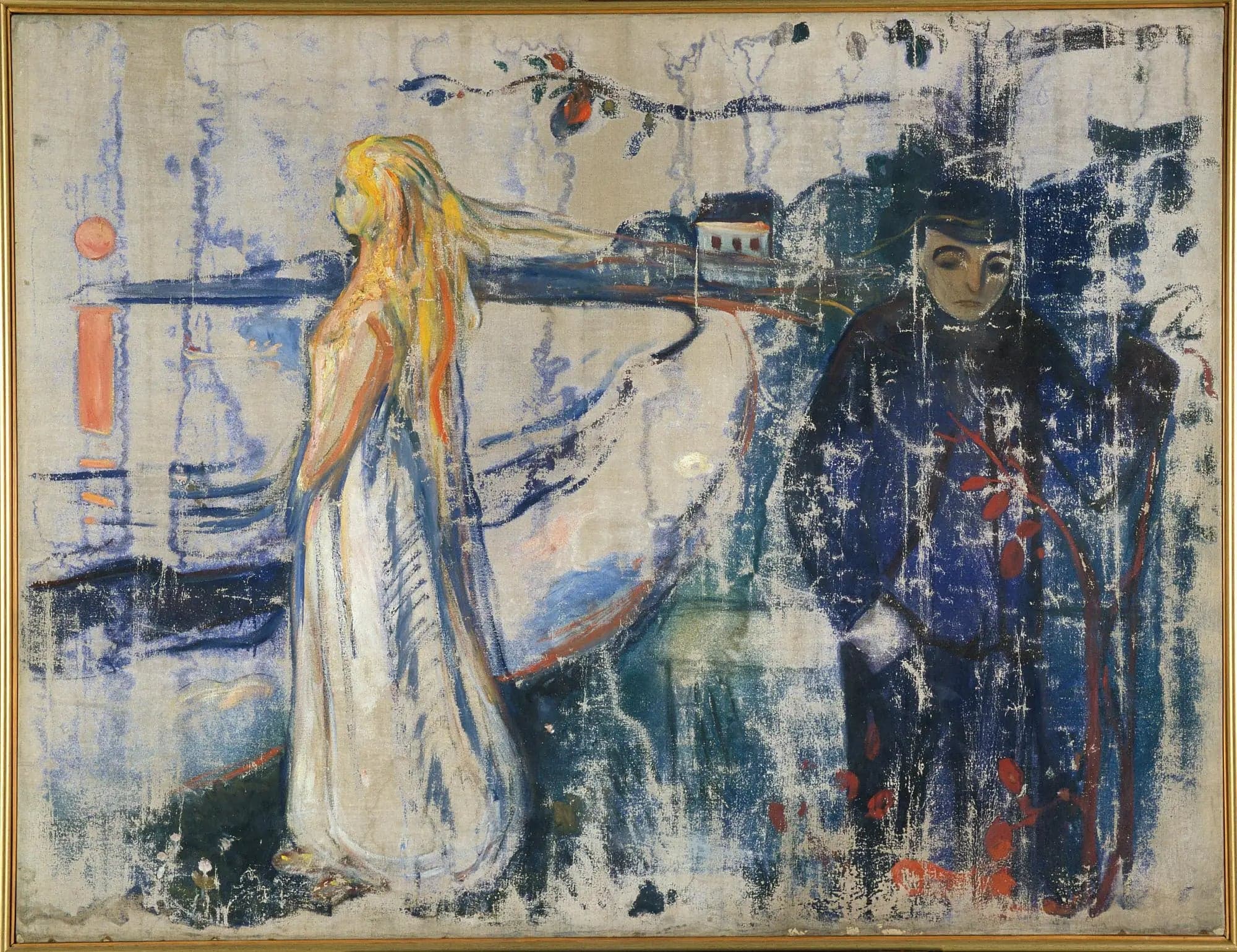
Separation
- Original dimensions
- 127 x 96 cm
- Museum
- Munch Museum
- Year
- 1896
Scene depicted
The painting Separation highlights a couple who seem to be engulfed in deep melancholy, capturing the fleeting moment of an emotional breakup. The figures stand apart, embodying solitude and sadness, while a dark and troubled landscape envelops the scene. Munch, with his uniqueness, depicts not only a physical separation but also an emotional schism, resonating within each of us with palpable intensity.
Historical context
Created in 1896, this painting echoes a time marked by introspection and exploration of the human psyche. Edvard Munch , rooted in Oslo, then Christiania, created this iconic painting at the heart of the symbolist movement, which transcends the boundaries of classical representation to address deep emotions. The painting is currently housed in the Munch Museum in Norway, measuring 127 x 96 cm, a living embodiment of its creator's sensitivity.
Place in the artist's career
This painting , emblematic of Edvard Munch's artistic maturity, surpasses his beginnings with The Dance of Life and heralds the darker explorations of The Scream . In this context, Separation represents a turning point in his journey, where technique flourishes and emotions assert themselves, propelling the artist to the heights of expressionism .
Anecdote
Edvard Munch once said: “Every work is a cry from the heart.” It was on a spring morning, by a lake in Oslo, that he captured the essence of the canvas Separation, inspired by an evanescent silhouette that passed by, leaving his soul in turmoil. The strength of this emotion finds refuge in his masterpiece , and each brushstroke becomes a silent confession.
Major exhibitions
Munch and France