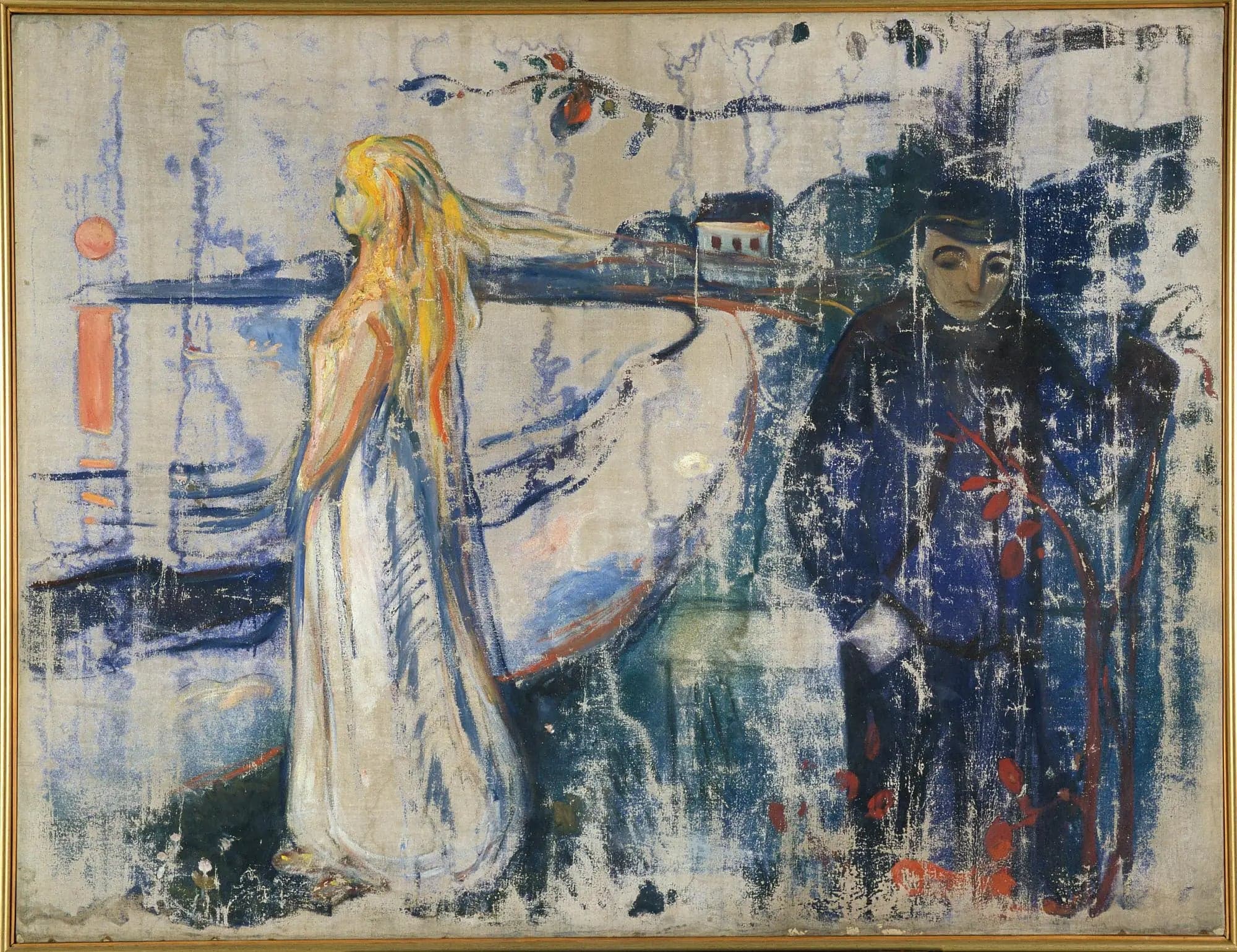
Separation
- Original dimensions
- 150 x 115 cm
- Museum
- Munch Museum
- Year
- 1894
Scene depicted
The painting “Separation - Edvard Munch ” illustrates a moment of palpable sadness, where two figures stand apart, lost in the intimacy of their thoughts, suggesting a deep separation. The silhouettes drift away, leaving behind an atmosphere charged with contradictory emotions, inviting the viewer to question the complex nature of human relationships.
Historical context
Created in 1894, the painting emblematic of Edvard Munch was born in the heart of Oslo, Norway, during a period of emotional and artistic upheaval marked by the beginnings of modernism. This work belongs to the expressionist movement, famous for its ability to capture human feelings in all their intensity. Currently, this canvas is located at the Munch Museum, where it attracts visitors from around the world fascinated by the depth of its expressive content.
Place in the artist's career
“Separation” marks a major turning point in Munch's career, reflecting his evolution towards a more personal and expressive representation of human suffering. Alongside other works such as “The Scream” and “The Madonna,” this painting reveals his unique ability to express human emotions through a deeply subjective lens.
Anecdote
“Every separation is a suffering, but in every suffering, there is a hidden beauty.” Munch recalls the day he gave birth to this canvas . He painted it by the edge of a lake, on a misty morning where the silence of the waters whispered dissonant and poignant emotions to him, thus capturing the very essence of this painting .