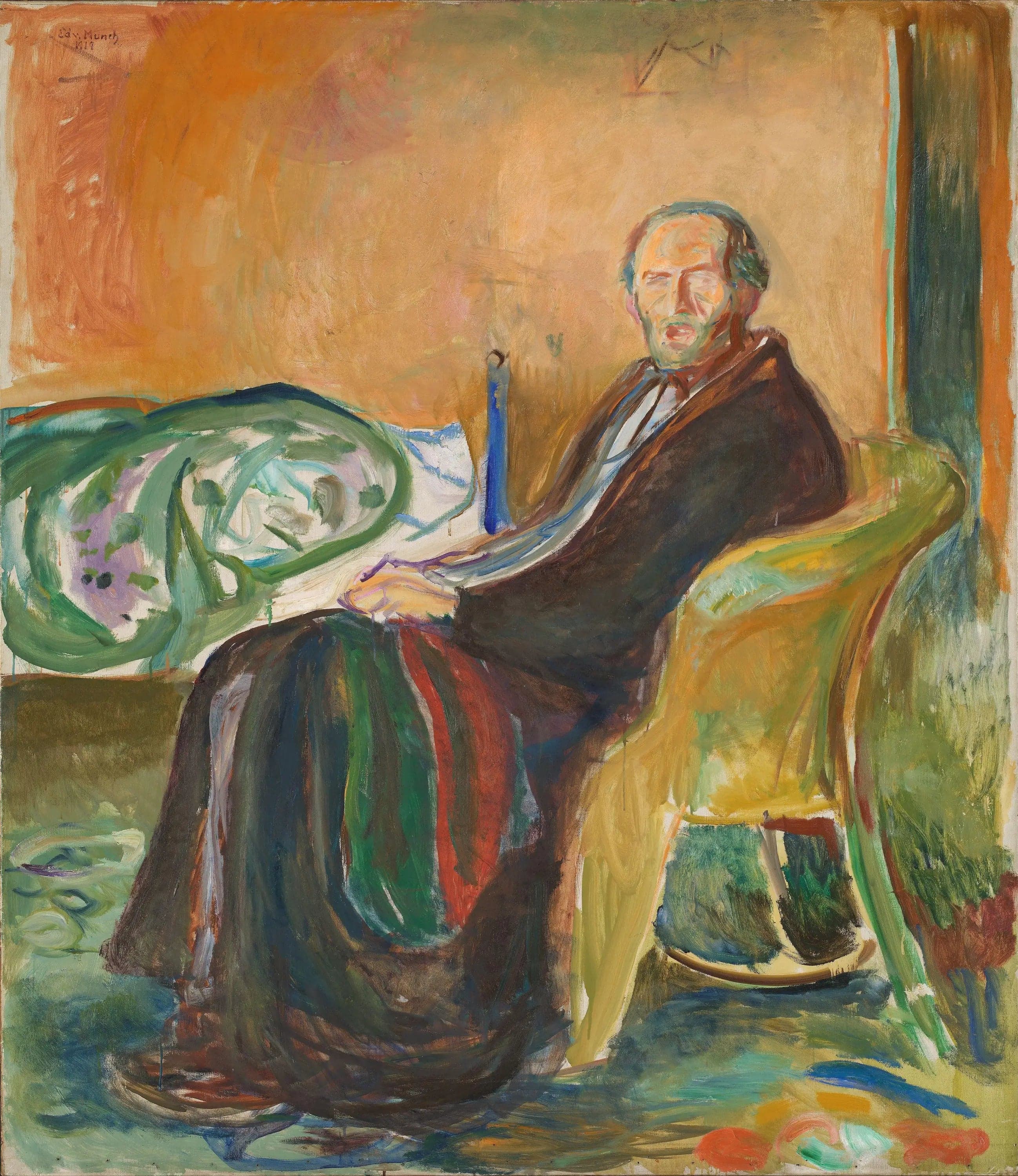
Self-Portrait with Spanish Flu
- Original dimensions
- 131 x 150 cm
Scene depicted
In this canvas , Munch self-represents as vulnerable, his emaciated silhouette surrounded by a dark atmosphere, symbolizing the weight of illness. The blurred contours and muted colors evoke suffering, while a breath of life persists in his gaze. Each brushstroke tells a story of despair and hope, capturing the very essence of human existence beset by illness.
Historical context
Œuvre : Self-Portrait with Spanish Flu |BRK| Artiste : Edvard Munch |BRK| Année : 1919 |BRK| Musée : National Gallery of Oslo |BRK| Dimensions : 131 x 150 cm |BRK| Expositions majeures : Jubileumsutstilling: 1814-1964 |BRK|
Place in the artist's career
This canvas represents a turning point in Munch's career, a reflection on his artistic journey. After works like “The Scream” and “The Madonna,” his self-portrait reveals a period of maturity. Through this painting , he merges his usual expressionism with poignant introspection that marks his technical and emotional evolution.
Anecdote
Munch stated: “Pain is universal, it connects us all.” This quote resonates deeply in the painting he created while he himself was struggling with illness. Imagine him, sitting at his easel, the outside world asleep under the mists of the flu, while a ray of light filtered through the shutters, illuminating his pale face. This raw emotion is found in the evocative strength of this masterpiece .