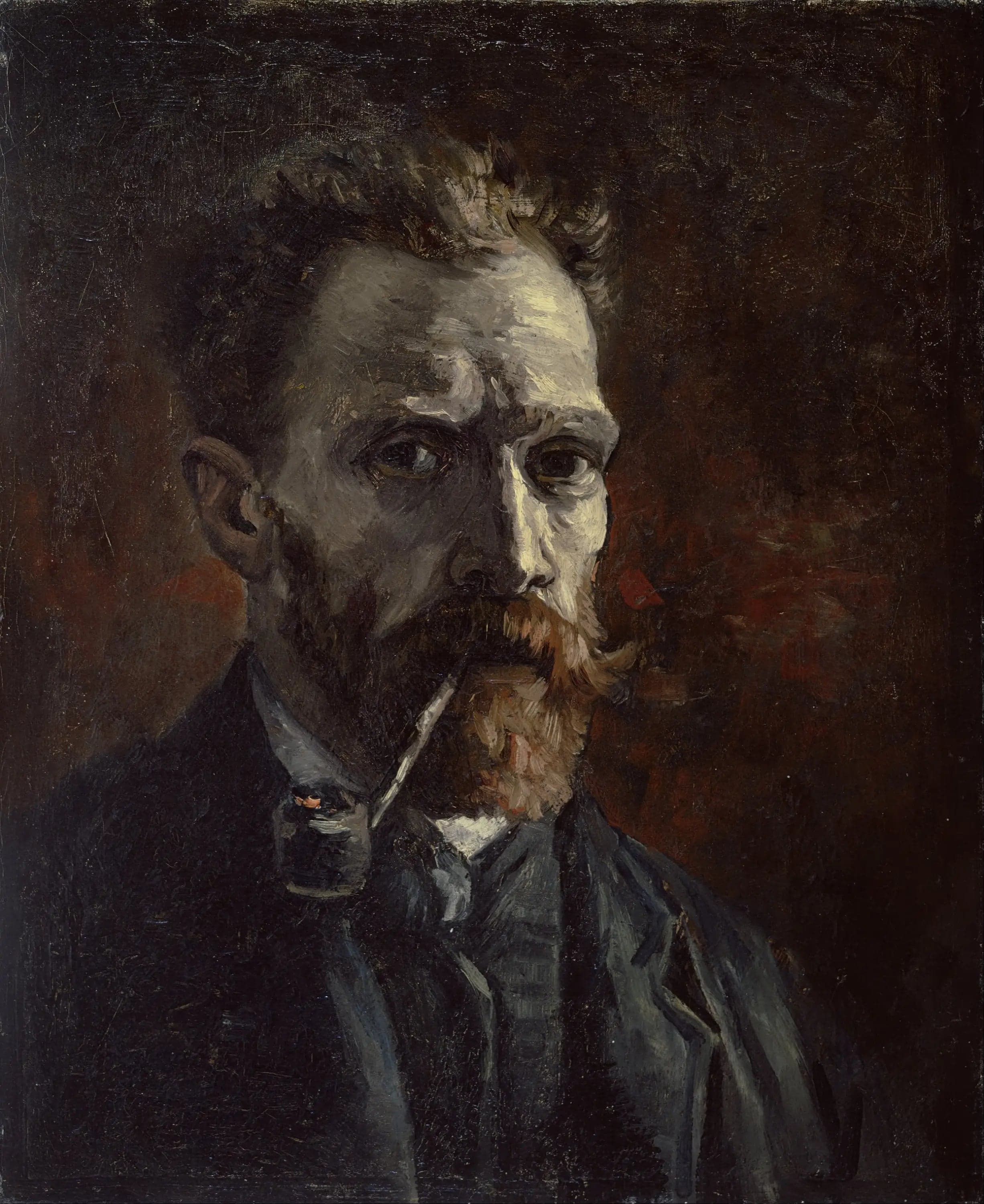
Self-Portrait with Pipe
Scene depicted
In this fascinating painting, Vincent van Gogh depicts his contemplative face. The wooden pipe, held between his lips, evokes reflection on his past and passions. The self-analytical gaze he casts upon himself becomes an invitation for the viewer to share his universe, at the intersection of reality and creation.
Historical context
Created in 1886, in Paris , Self-Portrait with Pipe is part of the post-impressionist movement, a rich period marked by a quest for new forms and colors. This painting, now exhibited at the Van Gogh Museum in Amsterdam, is one of the iconic works of Vincent van Gogh , measuring 38 x 46 cm and reflecting a deep introspection within a vibrant city.
Place in the artist's career
Self-Portrait with Pipe marks a significant milestone in the evolution of Vincent van Gogh . At this time, he explores a more complex palette, alongside works like the painting “ The Starry Night ” and “ The Sunflowers ”, thus revealing the intensity of his artistic vision and the culmination of his technical mastery.
Anecdote
“I paint memories, emotions. Each brushstroke carries a part of me.” While contemplating his reflection one spring morning in a Parisian café, Vincent grabs his pipe and begins to apply bold strokes on the canvas. The emotion emanating from this scene resonates in the evocative strength of the self-portrait .