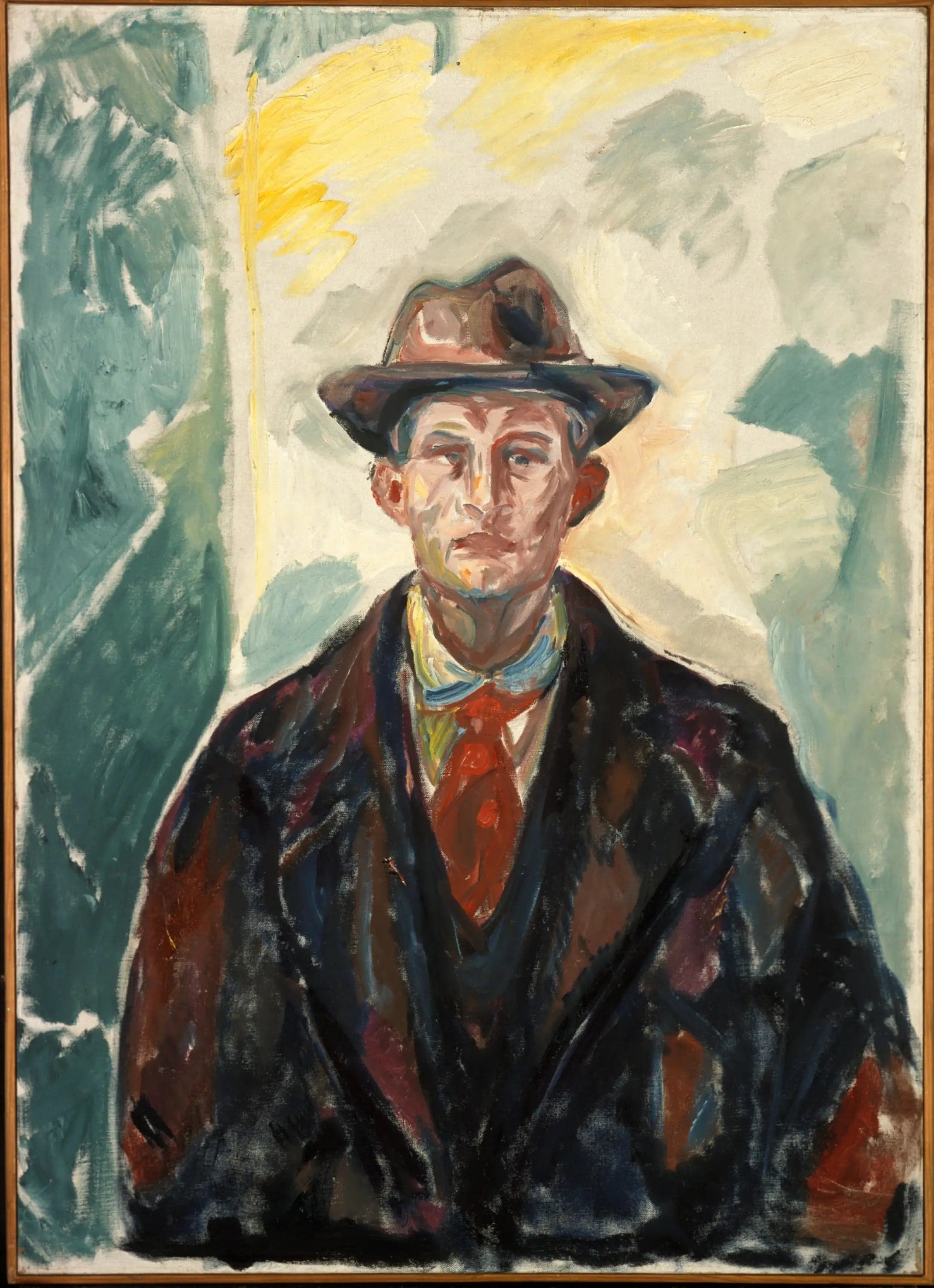
Self-Portrait with Hat and Red Tie
- Original dimensions
- 75.5 x 105 cm
- Museum
- Munch Museum
- Year
- 1915
Scene depicted
This painting presents itself as an introspective exploration of the artist, where the firm posture and marked features invite the viewer to dive into the intimacy of his psyche. The gazes exchanged with the observer reveal a depth of feeling, draped in a melancholic atmosphere typical of Munch's work. It is a scene that speaks of inner struggle and repressed emotions, a self-representation at a crossroads.
Historical context
Created in 1915, this canvas embodies its roots in Oslo, Norway, where Edvard Munch , a central figure of symbolism and expressionism , redefined the artistic conventions of his time. The painting is currently displayed at the Munch Museum, where it shares space with other major works by the artist, measuring 75.5 x 105 cm, it testifies to a powerful and poignant artistic legacy.
Place in the artist's career
“Self-Portrait with a Red Hat and Tie” fits into a period of maturation for Munch, characterized by increased emotional depth. Alongside works such as “The Scream” and “The Madonna,” this painting illustrates a movement towards more personal and introspective representations, reflecting both technical and emotional evolution over the years.
Anecdote
“Truth is not for all men, but only for those who seek it.” These words from Munch resonate throughout his painting . Inspired by a moment of deep solitude in a spring grayness, the artist manages to capture an authentic and vibrant expression in his masterpiece . The shadow of the hat and the bright color of the tie reflect his state of mind, vibrant with contradictory emotions.