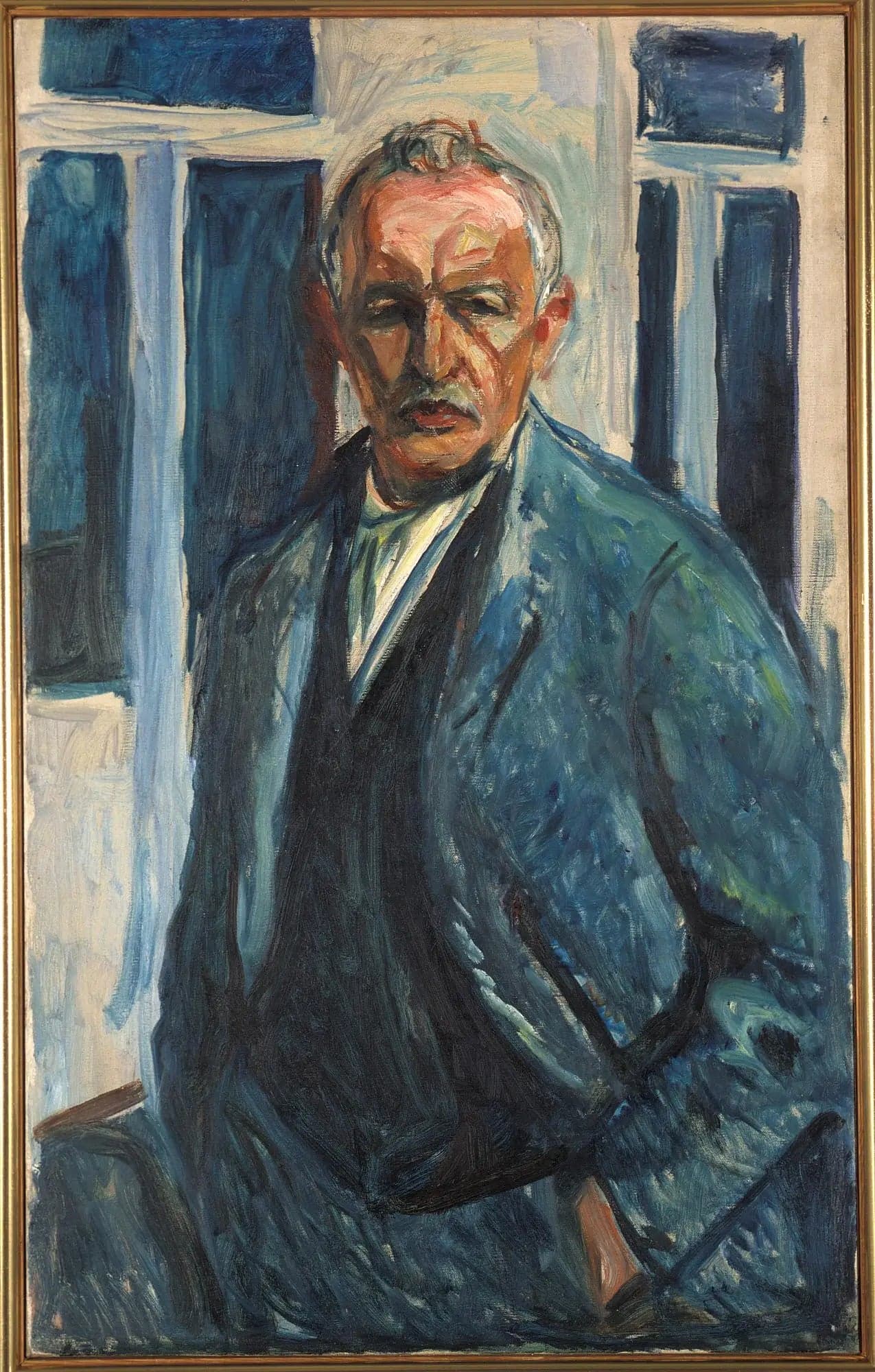
Self-Portrait with Hands in Pockets
- Original dimensions
- 65 x 104 cm
- Museum
- Munch Museum
- Year
- 1923
Scene depicted
In this emblematic work, Munch presents himself with his hands in his pockets, a posture that speaks of vulnerability and detachment. The gaze, both introspective and troubled, draws the viewer into a universe where silence speaks. Each stroke of the canvas suggests a reflection on isolation and the human condition, recurring themes in the production of this innovative artist.
Historical context
Created in 1923, in the city of Oslo, this painting by Edvard Munch is part of the Symbolist movement, a period where emotion and introspection blend on the canvas. In the context of post-war Europe, Munch's work stands out for its exploration of the depths of the human soul. The masterpiece is currently exhibited at the Munch Museum, where it can be admired in all its splendor, measuring 65 x 104 cm, a size that imparts both impact and intimacy.
Place in the artist's career
Self-Portrait with Hands in Pockets is situated at a pivotal moment in Munch's career, where he reaches remarkable artistic maturity. This painting can be paralleled with other works such as The Scream and The Madonna, revealing a stylistic and emotional evolution in his exploration of human emotions and existential angst, a constant in his pictorial oeuvre.
Anecdote
“My painting is not just an image, it is a confession,” said Munch. Perhaps, this painting was inspired one foggy morning, in a quiet alley, where he was struck by the reflection of his own being. This note of melancholy and contemplation resonates in the very essence of the self-portrait — a powerful introspection that echoes through the ages.
Major exhibitions
Munch og Ekely: 1916-1944