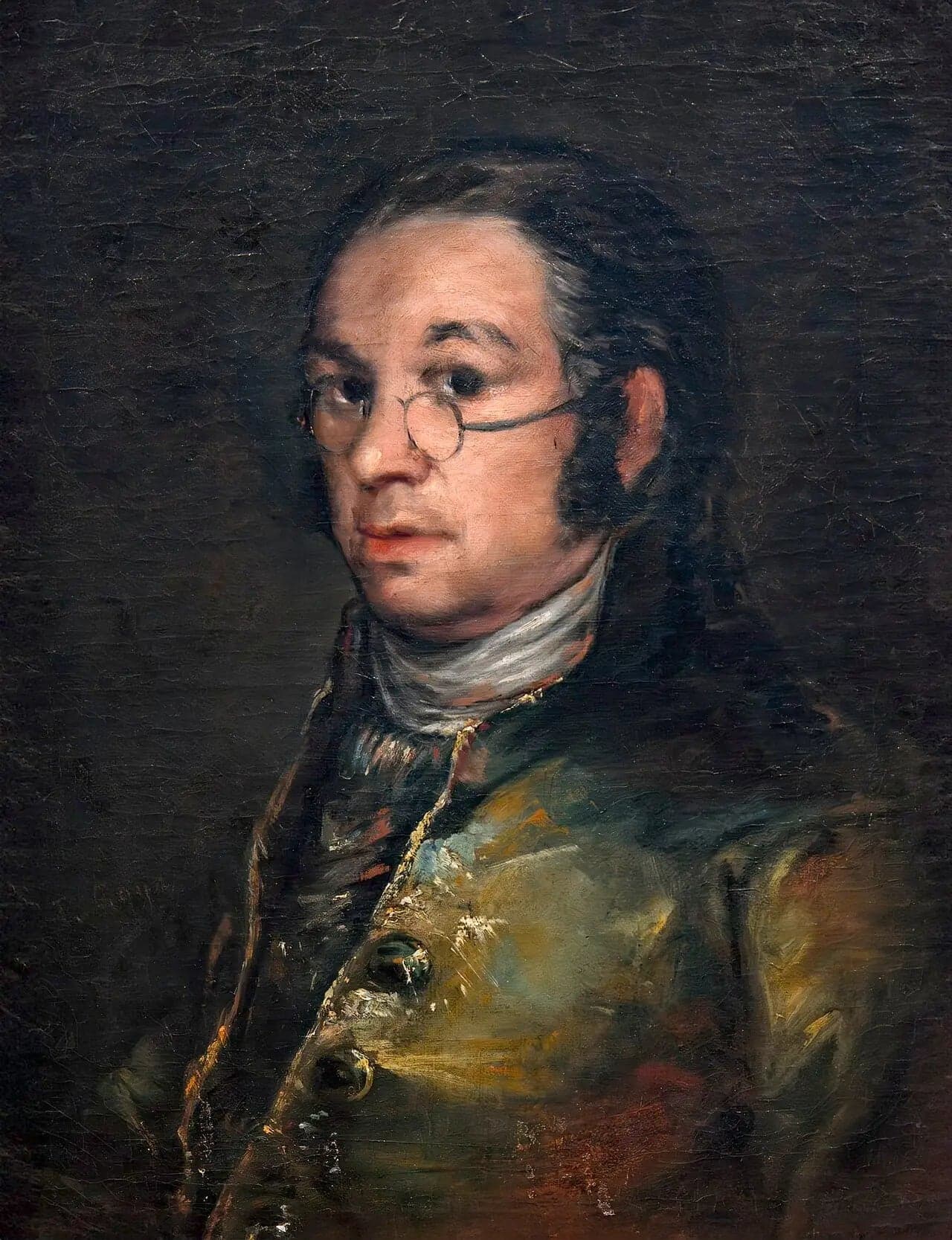
Self-Portrait with Glasses
- Original dimensions
- 47.8 x 61.5 cm
- Museum
- Goya Museum
- Year
- 1800
Scene depicted
In this painting , Goya reveals himself with palpable introspection. Illuminated by soft light, his face is adorned with glasses, revealing both vulnerability and wisdom. The composition invites one to dive into a meditation on perception and gaze, where the artist positions himself as both observer and observed. This portrait is an open window into Goya's soul, and by extension, into that of his time.
Historical context
Created in Madrid at the turn of the 19th century, this iconic canvas is part of the romantic movement, which breaks free from neoclassical conventions. Goya, a court painter who became a chronicler of human suffering, immortalizes his image here by wearing glasses, a symbol of wisdom and discernment. Currently exhibited at the Goya Museum, this painting resonates with the aura of a tumultuous era rich in artistic transformations.
Place in the artist's career
Self-Portrait with Glasses sits at the heart of Goya's career, marking his transition towards greater introspection. This painting foreshadows his later works such as “The Disasters of War” and “The Naked Maja,” where he skillfully combines personal representation and social engagement. This moment of maturity proves key in his stylistic evolution.
Anecdote
“Art must immerse the soul in an ocean of reflections.” Such is the phrase one might attribute to Goya as he sketched his masterpiece one summer morning in Madrid. Inspired by the golden light filtering through the windows, he faces his own reflection, a play of gazes between the artist and his inner world, capturing the very essence of humanity. In this painting , he transcends the simple self-portrait to assert himself as a thinker of his time.