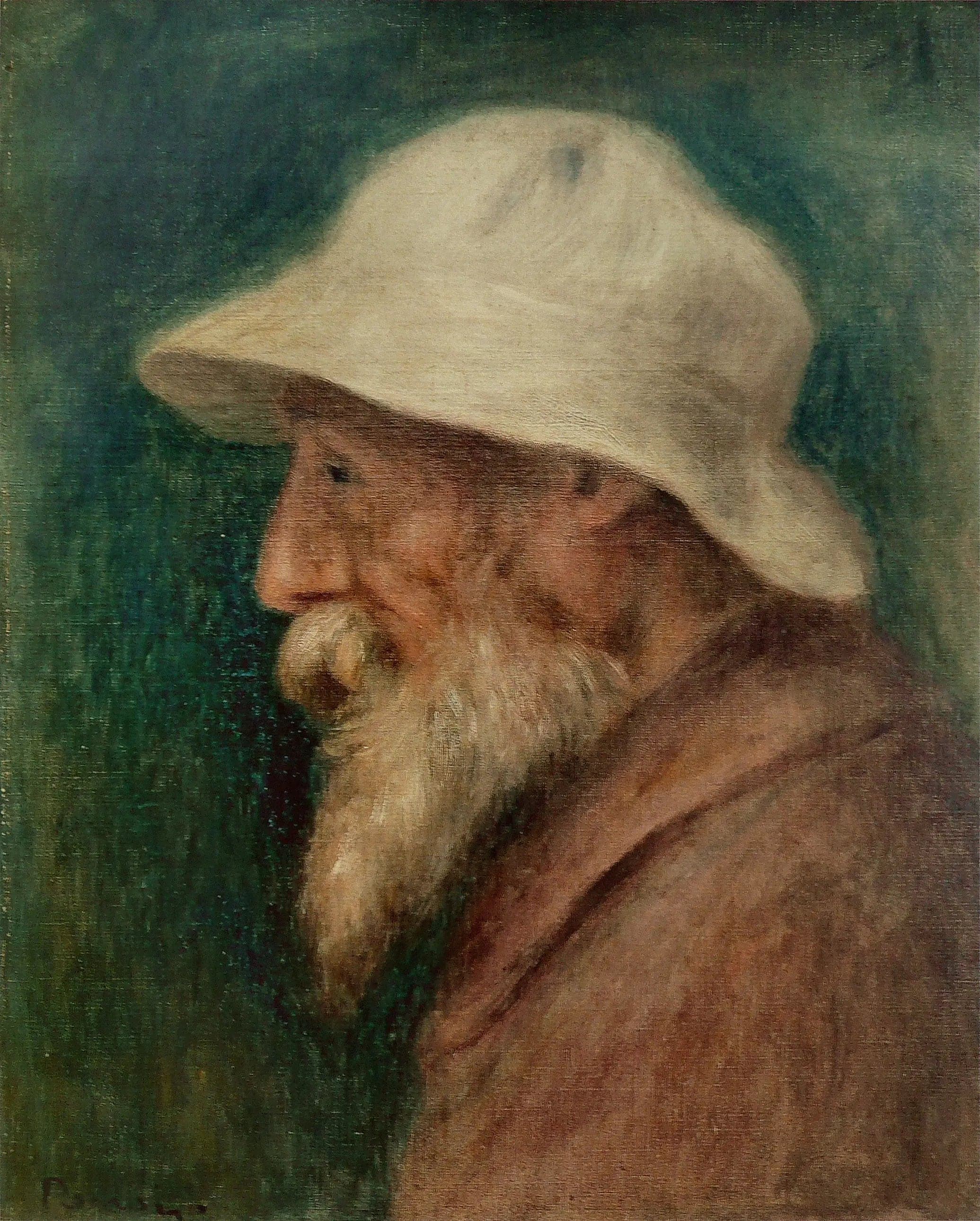
Self-Portrait with a White Hat - Pierre
- Original dimensions
- 33 x 42 cm
- Museum
- Not specified
- Year
- 1910
Scene depicted
The painting “Self-Portrait with a White Hat” presents the painter himself, in a vibrant composition where he projects himself with confidence. The masterpiece embodies introspection, revealing a man at the peak of his career, combining technical mastery and emotion. The features of his face, imbued with softness, are bathed in a gentle light, symbolizing his commitment to authentic expression.
Historical context
Created in 1910, this painting emanates from the Paris of the Belle Époque, a time when Impressionism was giving rise to new artistic horizons. Self-Portrait with a White Hat is part of Renoir's journey, a leading artist of the movement, whose works continue to soothe our senses and thoughts. Its current location is not specified, but it has likely passed through various collections, reflecting its timeless prestige. With dimensions of 33 x 42 cm, this canvas presents itself as a condensation of style and emotion, a masterpiece made of stories.
Place in the artist's career
This painting is situated at a turning point in Renoir's career, marked by aesthetic and emotional maturity. Alongside works like “Bal du moulin de la Galette” and “La Danse à la Ville,” Self-Portrait with a White Hat testifies to a stylistic evolution, seamlessly blending Impressionism and a more personal exploration of identity.
Anecdote
“I paint men, women, flowers, fruits, and everything I can.” said Renoir, revealing his passion for life. Perhaps this painting was born from a gentle sunny morning, when the artist, wearing his white hat, was struck by the light caressing his face. This fleeting moment captured not only his appearance but also the emotion of existence, making this canvas a mirror of the soul.