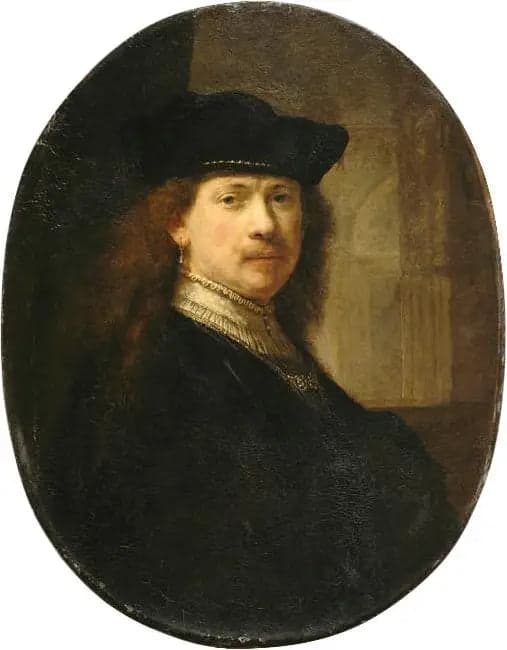
Self-Portrait with a Hat against an Architectural Background
- Original dimensions
- 62 x 80 cm
- Museum
- room 844
- Year
- 1639
Scene depicted
In this painting , Rembrandt presents himself with a cap, highlighting his status as an artist while recalling the depth of his journey. The composition, rich in architectural details in the background, echoes a world that is evolving, where each element of his portrait becomes a symbol of the tensions between artistic aspiration and the realities of life. Through this pictorial work, the artist takes us on an introspective journey, a mirror of his time in constant resonance.
Historical context
Created in 1639, this major work by the Dutch painter Rembrandt is part of the rich movement of Baroque , which permeates the city of Amsterdam, then in full artistic effervescence. The painting , displayed in room 844 of the museum, captures the intensity of a time when art becomes an immediate reflection of society and man. Its size, 62 by 80 centimeters, makes it both an imposing and intimate painting , inviting viewers to engage in a deep visual dialogue.
Place in the artist's career
This painting , emblematic among his self-portraits, represents a crucial milestone in Rembrandt 's career. It marks a period of maturity, at a time when he perfected his style. Alongside other paintings such as “The Night Watch” or “The Anatomy Lesson of Dr. Tulp”, one perceives the evolution of his technique and the intensification of the expression of light, merging realism and emotion.
Anecdote
“Every brushstroke reveals the soul of the observer” could have said Rembrandt , clad in his cap in his studio, immersed in the play of light dancing around him. This self-portrait, sketched on a peaceful morning, awakens in us the echo of past eras, a sweet melody resonating in space, merging the past and the present within this masterpiece .