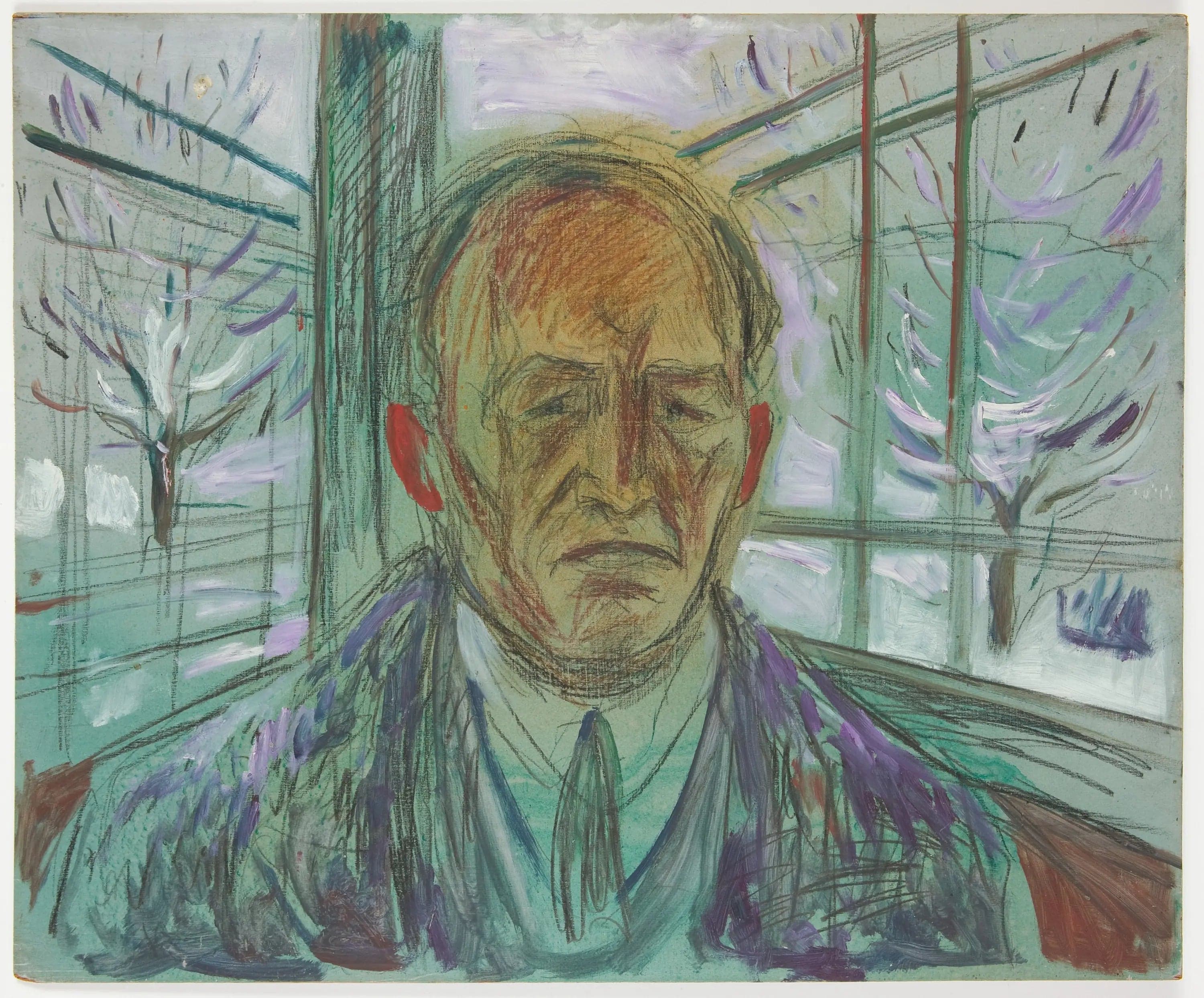
Self-Portrait on the Veranda
- Original dimensions
- 55.5 x 45.5 cm
- Museum
- Munch Museum
- Year
- 1930
Scene depicted
In the masterpiece “Self-Portrait on the Veranda,” Munch presents himself with an expression that is both introspective and detached. The veranda offers a scene of tranquility, where the surrounding nature seems to whisper secrets to him. Torn between shadow and light, the artist captures the very essence of existence, bringing to life a silent dialogue with his environment.
Historical context
This painting is emblematic and was created in 1930, in the peaceful setting of the Oslo region, Norway. The expressionist movement, to which Edvard Munch belongs, harmoniously reflects human anxiety and passion. Today, this canvas is displayed at the Munch Museum, where it continues to inspire and amaze viewers with its dimensions of 55.5 x 45.5 cm.
Place in the artist's career
“Self-Portrait on the Veranda” is part of a period of maturation for Munch, where he synthesizes his personal experience with his art. Compared to other works such as “The Madonna” and “The Scream,” this canvas illustrates his evolution, oscillating between emotional pain and a quest for serenity.
Anecdote
Edvard Munch once confessed: “Art allows me to express what words cannot convey.” It was a bright spring morning when, surrounded by the greenery of his veranda, he created this canvas that captures the daylight while remaining rooted in his introspection. A moment turned into eternity, resonating through every brushstroke.
Major exhibitions
Munch og Ekely: 1916-1944