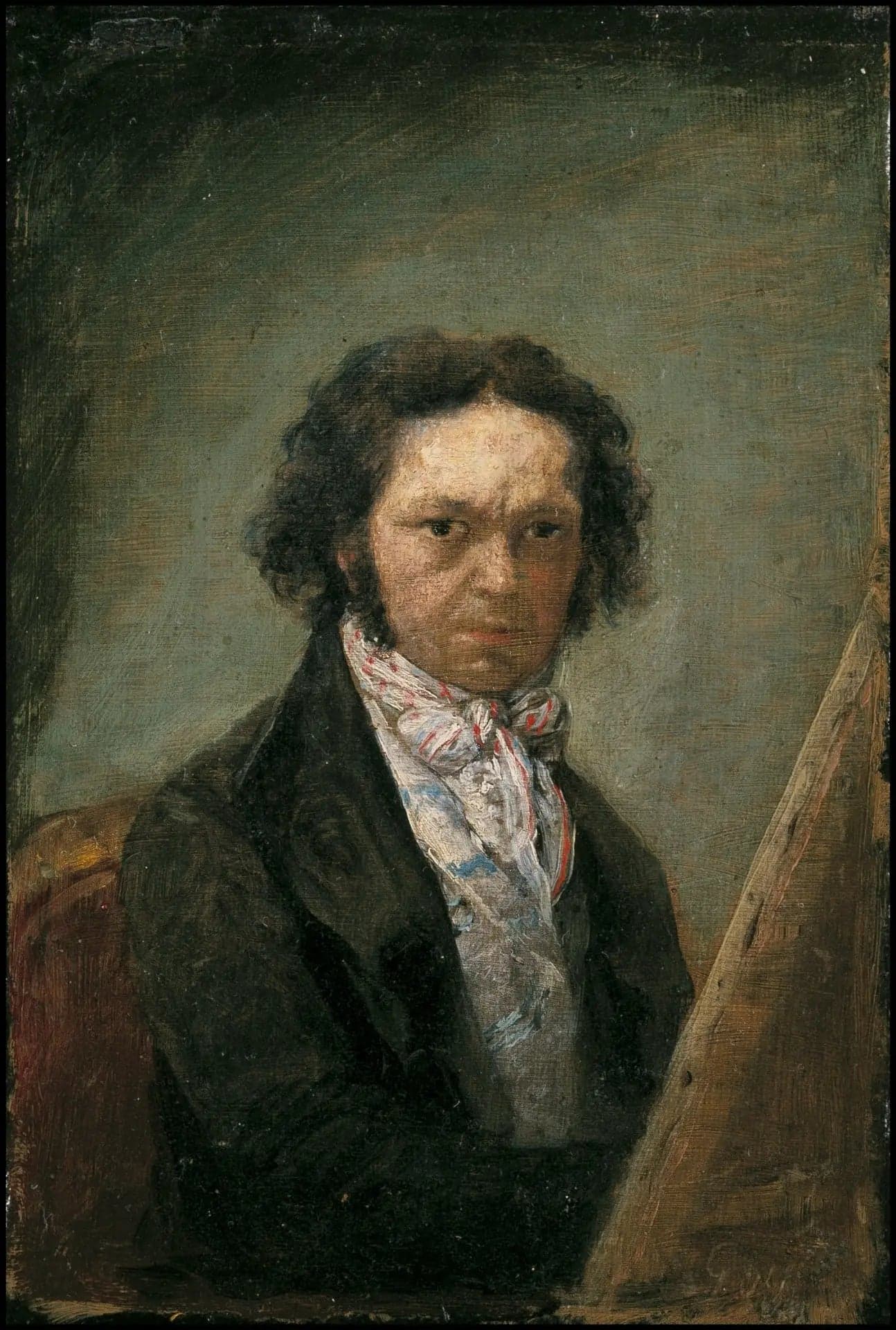
Self-Portrait on Linen
- Original dimensions
- 12.2 x 18.2 cm
- Museum
- Prado Museum
- Year
- 1790
Scene depicted
In this tiny painting, Goya presents himself with disarming frankness, his intense gaze inviting deep contemplation. The artist seeks to show not only his face but also his inner essence. The shadow and light in the composition reveal a dialogue between vulnerability and strength, a duality that echoes his tumultuous journey.
Historical context
Created in 1790 in Madrid, this iconic work is part of the emerging romantic movement, where the expression of human emotions begins to be felt. This painting, currently displayed at the Prado Museum, testifies to Goya's boldness and stylistic uniqueness at that time, where the artist ventures beyond conventions to capture the depth of the human soul.
Place in the artist's career
At the threshold of his career, this painting marks the beginning of a personal and technical exploration that will culminate in works like "The Caprices" and "The Colossus." Goya, with this painting , opposes his reflections on art and the human condition, thus positioning himself as a precursor of modern art.
Anecdote
Francisco de Goya once said: "Painting is the art of evoking the invisible and making the soul visible." This brushstroke, given under the soft light of a summer morning, resonates with intimate melancholy and introspection. This moment of inspiration gave birth to a masterpiece that invites the viewer to dive into the meanders of their own being.