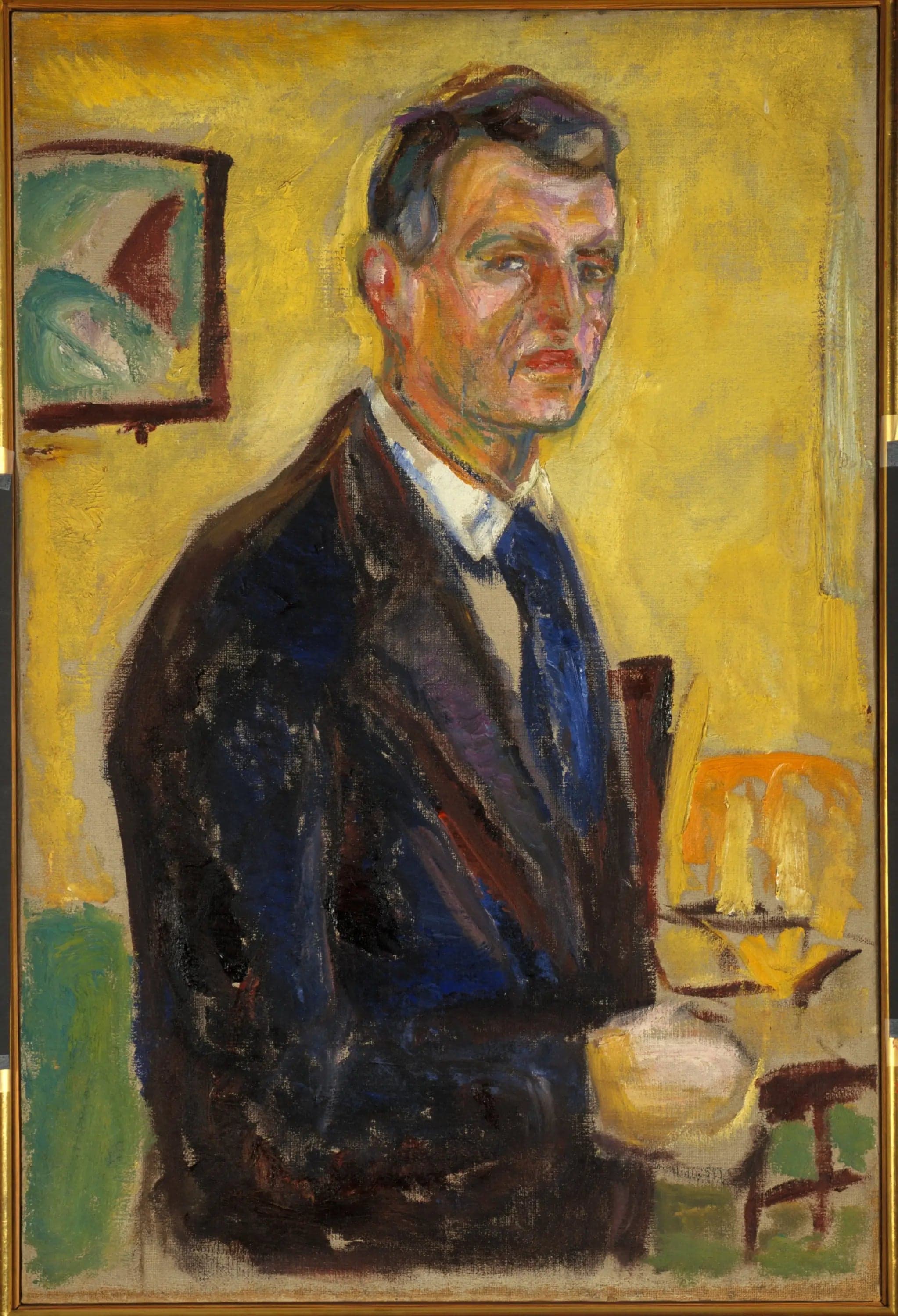
Self-Portrait on a Yellow Background
- Original dimensions
- 67 x 100 cm
- Museum
- Munch Museum
- Year
- 1915
Scene depicted
In this canvas , Munch presents us with his self-portrait against a bright yellow background, a color that evokes both warmth and anxiety. The composition is structured around his face, whose features express palpable melancholy. The painting offers a realistic vision while being imbued with expressionism , revealing the artist's internal struggles in relation to his environment.
Historical context
Created in 1915, this painting finds its roots in the vibrant context of Oslo, Norway, which was then a hub of the expressionist movement. Edvard Munch , an icon of this era, captures the complexity of the human soul through his canvas . Today, the masterpiece resides in the Munch Museum, testament to the artistic legacy of the artist.
Place in the artist's career
Munch's self-portrait marks a pivotal period in his career, illustrating his transition to a more personal and emotional expression. Compared to “The Scream” and “The Madonna,” this canvas shows how the artist evolves in his technique, manipulating color and emotion to convey striking depth.
Anecdote
“In every self-portrait, I seek to capture the reflection of my own soul,” said Munch. This canvas is inspired by a sunny morning, the artist contemplating his face through a mirror, akin to a deep introspection. It is this golden light that mingles with a nostalgic shadow, creating a strong emotional concentration in his painting .